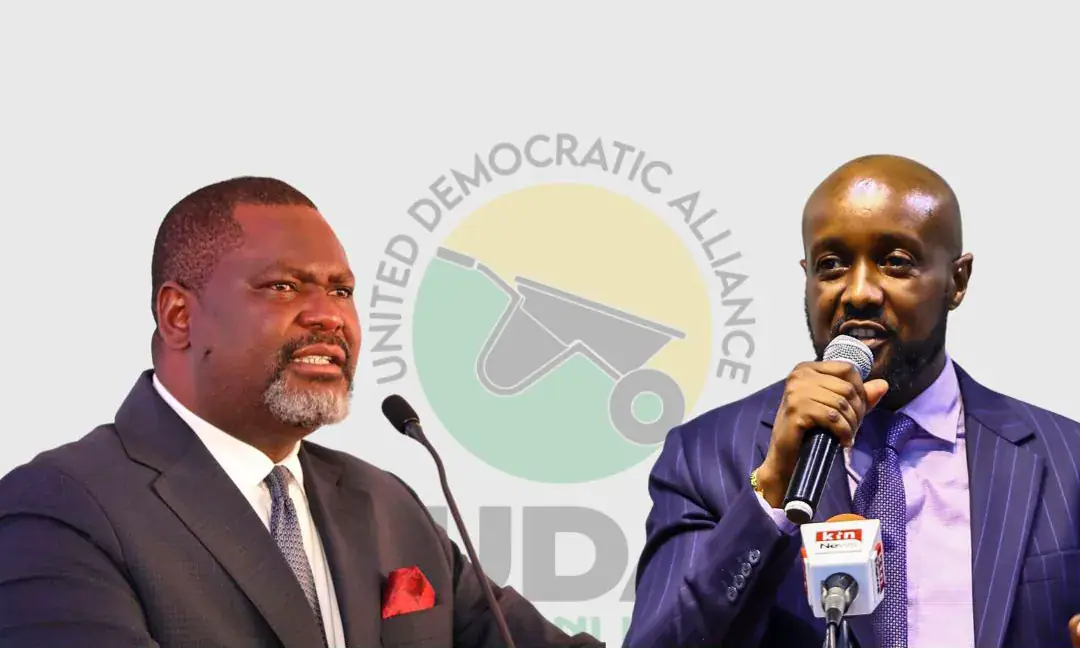
Kenya's political landscape is shifting as two prominent leaders, Geoffrey Ruku and Ronald Karauri, have announced their bids for the Nairobi governor seat on the United Democratic Alliance (UDA) ticket. This development sets the stage for a competitive contest, potentially testing President William Ruto's influence within his party. Both Ruku, the Cabinet Secretary for Public Service, and Karauri, the Member of Parliament for Kasarani, are vying for the position, which is currently held by Governor Johnson Sakaja, who recently defected to the Orange Democratic Movement (ODM).
Ruku and Karauri's entry into the race has sparked interest, with each presenting their unique qualifications. Ruku, with his experience as a legislator and Cabinet Secretary, positions himself as a seasoned administrator. In contrast, Karauri cites his achievements in Kasarani, aiming to leverage his local track record to garner support. Karauri's reception into UDA on November 9, in the presence of top party officials, including Leader of Majority Kimani Ichung'wah and Secretary General Hassan Omar, has fueled speculation about his prospects.
The UDA party has become a focal point of interest, especially after Karauri's formal acceptance. Ichung'wah revealed that President Ruto had personally directed him to welcome Karauri into the party, suggesting a level of endorsement. However, Ruku remains confident in his own bid, emphasizing his alignment with UDA's principles and his long-standing connection to Nairobi, where he has lived since he was 18 years old and where his five children were born and educated.
Despite both leaders' assertions of commitment to UDA, their paths to the nomination differ. Ruku, who was initially elected to Parliament under the Democratic Party (DP) before resigning to become a Cabinet Secretary, insists that his shift to UDA is genuine. He criticizes Karauri's record in Kasarani, questioning his impact on the constituency. This exchange highlights the competitive nature of the race and the strategies each candidate is employing to win over voters.
The race for the UDA nomination also involves Patrick Musili Mbangula, who has stated he will not withdraw despite Karauri's entry. This development indicates a potentially crowded field, which could complicate the party's nomination process. Ruku has expressed his willingness to support whoever wins the UDA nomination fairly, while Karauri has cautioned that he might consider running as an independent if he perceives any irregularities in the process.
The broader context of the 2027 Nairobi governor's race is significant, with the city now having 2.7 million registered voters, a substantial increase from the 699,000 votes that secured Sakaja's position in 2022. The incumbent governor's decision to seek a second term under ODM has opened up opportunities for other parties, including UDA, to challenge for the seat. Ruku and Karauri's campaigns will likely focus on addressing critical issues such as waste management and water scarcity, which have been points of contention in the city's governance.
As the campaigns intensify, the competition between Ruku and Karauri, along with other aspirants, will be closely watched. Their ability to connect with Nairobi's diverse population and articulate compelling visions for the city's future will be crucial. The UDA nomination process, and the eventual outcome of the governor's race, will provide insights into the party's internal dynamics and its strategy for the 2027 elections.
Key points
- The race for the Nairobi governor seat on the UDA ticket involves Geoffrey Ruku and Ronald Karauri, who are leveraging their experience and local connections to garner support.
- The competition is set to test President William Ruto's influence within UDA and could indicate the party's prospects in the 2027 elections.
- The eventual candidate will face a significantly expanded voter base in Nairobi, with 2.7 million registered voters, in their bid to succeed Governor Johnson Sakaja.
Reporting sources
- Ruku aambia Karauri hiyo tiketi ya ugavana aliyoifuata UDA pia yeye anaitaka · taifaleo.nation.co.ke