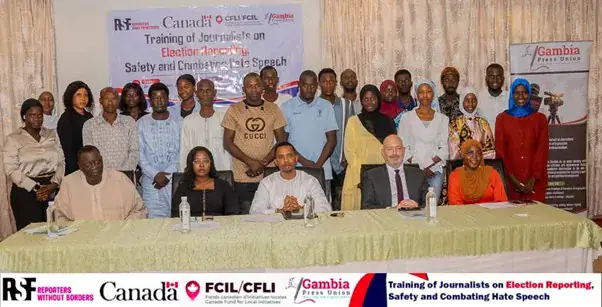
Reporters Without Borders (RSF), in collaboration with The Gambia Press Union (GPU), has commenced a three-day training for 25 journalists on election reporting, journalist safety, tackling disinformation, and hate speech. The training, funded by the Canada Fund for Local Initiatives (CFLI), aims to equip journalists with skills to manage physical and digital risks, report elections fairly and accurately, and address censorship, disinformation, and hate speech. This initiative is crucial as The Gambia prepares for the December 5, 2026 presidential election and subsequent electoral cycle ending in May 2027.
Minister of Information, Dr. Ismaila Ceesay, delivered the keynote address, emphasizing the timeliness of the training. He noted that election reporting comes with heightened tensions and safety risks, stressing the importance of ensuring journalists' safety during elections. Dr. Ceesay also highlighted that disinformation and hate speech are global phenomena, citing recent elections in Brazil and elsewhere. He commended RSF and GPU, stating that strengthening journalists' capacity is an investment in democracy and the credibility of institutions.
Dr. Ceesay reminded journalists of their role in providing accurate information to help citizens determine the country's future. He urged them to prioritize accuracy over speed, warning that fabricated political statements or misleading information about election results can spread rapidly, confuse voters, and undermine public confidence. Journalists were advised to report only results officially announced by the Independent Electoral Commission (IEC) to avoid confusion and potential violence.
GPU President, Isatou Keita, emphasized that the training is critical during a period when demand for credible, accurate, and responsible journalism will continue to grow. She noted that citizens rely on journalists for information and clarity, especially during elections. Keita stressed that disinformation, online abuse, and pressure during elections require journalists to be equipped with tools, confidence, and support systems to work safely, ethically, and independently.
RSF's Project Officer for Sub-Saharan Africa, Ndeye Diary Ba, highlighted The Gambia's progress in press freedom, rising from 58th in 2024 and 2025 to 46th out of 180 countries in the 2026 World Press Freedom Index. She emphasized that fair, balanced, and independent coverage is a cornerstone of political pluralism and credible elections. Ba noted that electoral periods remain demanding due to political tensions and safety risks, stressing that the safety of journalists is a shared responsibility.
The representative of the Embassy of Canada, Martin Babin, expressed Canada's pride in supporting the initiative, emphasizing that journalists are essential to democracy. He noted that democracy cannot function without informed citizens, and informed citizens cannot exist without access to credible, independent, and professional journalism. Babin cited global statistics, stating that 25 journalists had been killed worldwide since the beginning of the year and 430 detained as of last week.
The training aims to enhance journalists' skills in reporting elections fairly and accurately, managing physical and digital risks, and addressing disinformation and hate speech. By equipping journalists with the necessary tools and support, the initiative seeks to promote credible and responsible journalism in The Gambia, ultimately contributing to a more informed and engaged citizenry during the electoral process.
Key points
- The training is funded by the Canada Fund for Local Initiatives (CFLI) and aims to equip journalists with skills to manage physical and digital risks.
- The Gambia has made progress in press freedom, rising to 46th out of 180 countries in the 2026 World Press Freedom Index.
- The safety of journalists is a shared responsibility involving the media, authorities, security forces, and electoral process stakeholders.