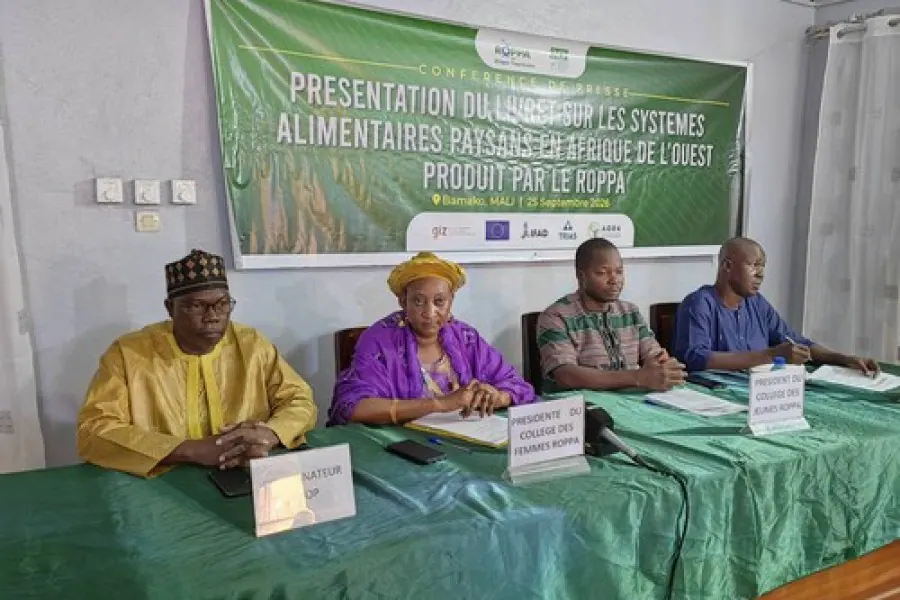
The Réseau des organisations paysannes et de producteurs de l’Afrique de l’Ouest (ROPPA) has called for a significant shift in West Africa's food policies, emphasizing the need to prioritize family farms, local markets, and peasant knowledge. This appeal was made during a conference in Bamako, where the organization presented a booklet outlining its proposals. The booklet is based on research conducted in nine countries between 2024 and 2026.
According to ROPPA, current food policies in West Africa do not adequately consider the realities of peasant farming systems. The organization's research highlights that family farms, which account for nearly 69% of the region's active population, play a crucial role in food production, transformation, conservation, consumption, and marketing. However, these farms face significant challenges, including climate change, environmental degradation, and limited access to resources.
The situation is further complicated by the growing threat of food insecurity in West Africa. In 2024, approximately 38 million people were affected by food insecurity in the region. With the population expected to grow, West Africa will need to increase its agricultural and agri-food production by at least 20% by 2050 to meet demand. ROPPA argues that supporting family farms and promoting local consumption can help address these challenges.
ROPPA advocates for a more supportive policy environment for family farms, including the development of local markets, short circuits, and direct sales to consumers. The organization also emphasizes the importance of territorial markets, which serve as the primary outlet for over 70% of family farm production in West Africa. However, these markets often lack adequate infrastructure, including conservation, storage, hygiene, and regulation facilities.
The organization also promotes the use of local resources and endogenous knowledge, particularly in agroecology. ROPPA believes that these practices can contribute to more sustainable production while reducing dependence on imported technologies. Additionally, the organization highlights the potential of local processing of agricultural products, which can create jobs and stimulate local economies.
ROPPA's proposals are built around five key orientations, including ensuring access to healthy and culturally adapted food, promoting sustainable consumption, supporting agroecology, and fostering equitable livelihoods. The organization is calling on governments, local authorities, research institutions, and civil society organizations to take action. ROPPA sees the renewal of agricultural policies in the UEMOA and ECOWAS regions as an opportunity to promote a new model of food production.
The organization aims to make family farms and peasant organizations key players in the definition, implementation, and monitoring of food policies. ROPPA's vision is to create a more territorially anchored food model, based on local resources, proximity markets, agroecology, and the participation of rural communities. The organization hopes that its proposals will contribute to a more sustainable and equitable food system in West Africa.
Key points
- ROPPA calls for a policy shift prioritizing family farms and local markets.
- West Africa needs to increase agricultural production by 20% by 2050.
- The organization promotes agroecology and local consumption to address food insecurity.