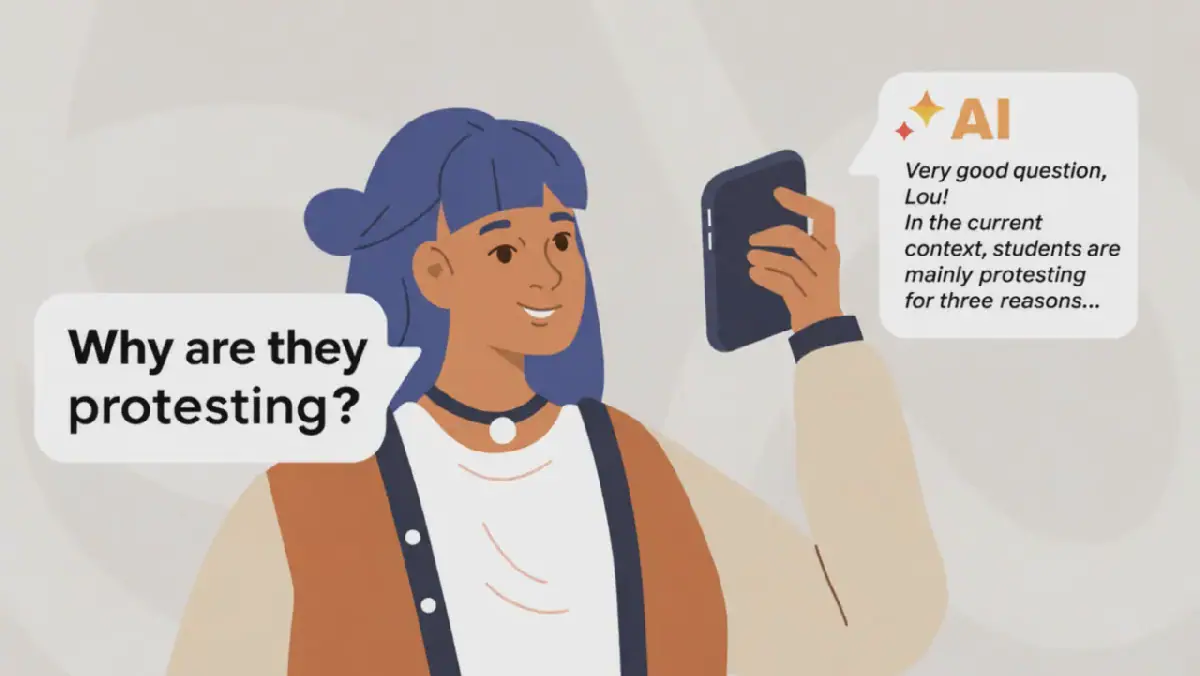
The increasing use of artificial intelligence for news consumption is transforming how people stay informed, offering insights into major events, summarising recent developments, and answering specific queries. A recent survey in France found that 30% of adults aged 18-75 use AI to stay informed at least weekly, with 14% using it daily. This trend reflects a broader global shift, with 10% of respondents across 48 countries reporting using a chatbot for news, up from 7% the previous year.
Many users are seeking personalised news experiences, turning to AI for updates and summaries. Vivian, who works in AI, uses Perplexity for updates and has set up ChatGPT for daily briefings on technology news. Others, like Luc, use AI to gain context on ongoing stories, often requesting summaries or earlier articles when news breaks. This convenience, however, has raised concerns about the reliability of AI-generated information.
Despite the growing reliance on AI for news, concerns have been raised about the accuracy of chatbot responses. A January survey revealed that 47% of those who use AI for news frequently verify the sources it cites. However, a BBC and European Broadcasting Union study found that 45% of responses from four AI assistants contained at least one significant error. This has led some users to exercise caution, with Luc learning to be more vigilant after encountering inaccuracies.
The influence of AI chatbots on the variety of news sources users engage with is also a concern. The technology often favours major English-language outlets while sidelining independent and local publications. This trend raises concerns for publishers already experiencing declining website traffic, with visits to 40 French news sites falling by 22.9% from September 2025 to September 2026.
The impact of AI-generated news summaries on traditional journalism is also being felt. Matthieu, a marketing director, acknowledged reading fewer articles due to the rise of AI-generated summaries but continues to seek in-depth analysis from podcasts and traditional journalism. He emphasises the value of human research in understanding complex subjects.
Researchers and experts are studying the implications of AI on news consumption. The Society and Consumption Observatory and the Jean-Jaurès Foundation conducted a study reflecting a broader global trend. According to research by the Reuters Institute for the Study of Journalism, only 1% of respondents consider chatbots their primary news source.
As AI continues to transform the way people consume news, users, publishers, and researchers must navigate the benefits and drawbacks of this technology. While AI offers a convenient and personalised way to stay informed, its reliability and impact on traditional journalism remain significant concerns. Users like Matthieu carefully select their news sources and cross-check AI information, highlighting the need for a balanced approach to AI-generated news.
Key points
- 45% of AI assistant responses contain significant errors.
Reporting sources
- Rising Use of AI for News Consumption: Can Its Information Be Trusted? · sierraleonetoday.co.com