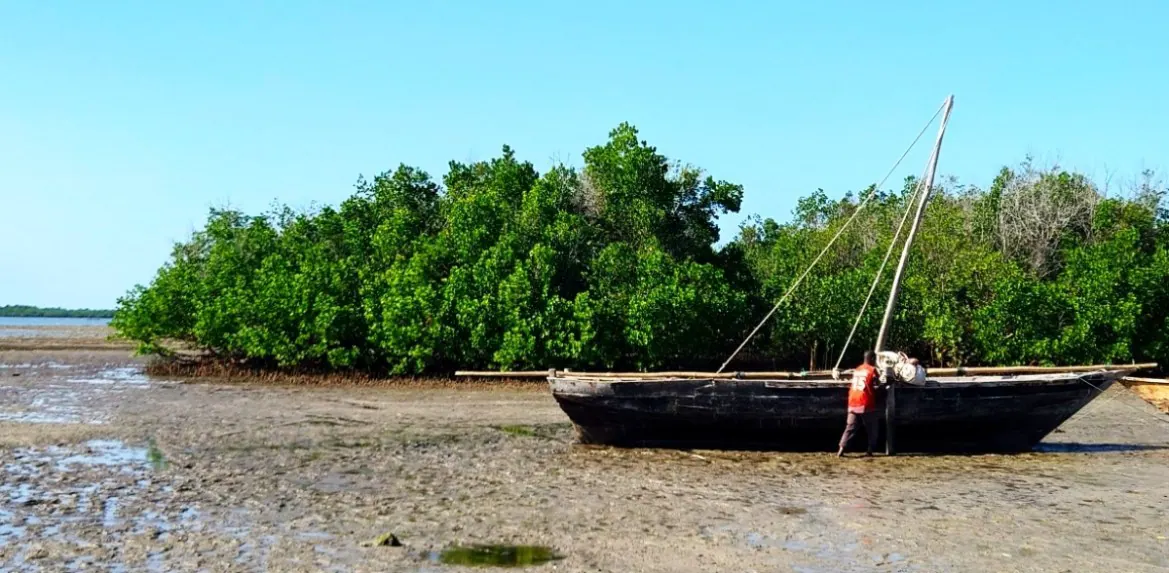
The effects of rising sea levels are being felt in Tanzania's Pangani District, where the Indian Ocean is rapidly moving inland, causing saltwater to push into fields that once sustained farmers along the Pangani river. Local farmer Buga Steven has seen a significant decline in his coconut harvest, from 5,000 coconuts to less than a third of that. The saltwater has also caused mangroves to grow inland, marking a boundary where land that once supported agriculture is becoming something else.
The historic town of Pangani, situated in a low-lying area, is experiencing the impacts of sea level rise firsthand. Farmers like Iddi Hashimu Iddi have watched as their coconut trees have become thinner and less healthy, with many dying due to the saltwater. The loss of coconut farming has had a ripple effect on the community, impacting not only farmers but also their families who depend on the income to sustain their livelihoods, educate their children, and meet social obligations.
The geography of the coconut trade is also shifting, with larger coconuts increasingly coming from higher ground. Haroub Selemani, a farmer and trader, notes that those living in lower-lying areas like Matakani to Jasini no longer have access to proper coconuts. Instead, they must go to places like Mafisi or Mseko, further uphill, to find larger coconuts. This change poses a dilemma for landowners, who must now compete with protected mangroves that are colonizing areas where coconut trees once grew.
The impact of rising sea levels is not limited to agriculture, as fishermen are also feeling the effects. Ali Hamis Daudi has seen changes in the shoreline and the loss of trees, making it difficult to anchor boats and find fish. The knowledge passed down through fishing communities about where particular species congregate and at what depth is becoming less reliable. Catching fish has become a struggle, and the changes unfolding in Pangani are a local expression of a global shift.
According to a report by the United Nations Secretary-General, nearly 770 million people live in coastal areas less than five meters above the high-tide line, and global mean sea level rose by an average of 4.7 millimeters per year between 2014 and 2023. In 2024, the annual increase reached a record 5.9mm. The rise is mainly driven by melting glaciers and ice sheets, and the expansion of seawater as the oceans warm.
Efforts to protect Pangani have taken several forms, including nature-based measures like mangrove planting and coral-reef restoration, alongside engineered defenses such as seawalls. UNEP's representative in Tanzania, Clara Makenya, notes that there is no single solution for the entire coastline and that a combined approach is likely to work best. However, some interventions have failed, such as attempts to plant mangroves in Magarawani, which were unsuitable due to the sandy terrain.
As the impacts of sea level rise continue to be felt in Pangani, the question of whether communities can adapt or will ultimately have to retreat will be discussed at a high-level meeting on the threats posed by sea level rise at UN Headquarters in New York on September 24. For the people of Pangani, however, the choices are already less abstract, with some calling for protection measures like seawalls, while others believe that compensation and relocation are the only viable options.
Key points
- Sea levels are rising at a rate of 4.7 millimeters per year, threatening the livelihoods of millions of people living in coastal areas.
- The impacts of sea level rise in Pangani District include saltwater pushing into fields, destroying crops, and threatening the livelihoods of local farmers and fishermen.
- Efforts to protect Pangani include nature-based measures like mangrove planting and coral-reef restoration, alongside engineered defenses such as seawalls.