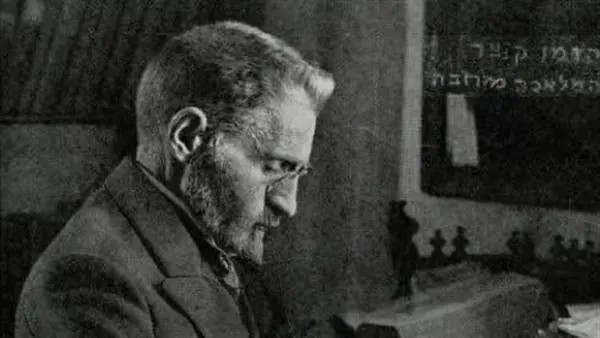
In the fall of 1881, a significant event took place in one of the old Jerusalem districts. Elazar Ben-Yehuda, a young Latvian-Russian immigrant, made a groundbreaking decision in the history of linguistics. He and his friends agreed to use only the Hebrew language in their daily conversations at home and in the street. This bold step marked the beginning of the revival of the Hebrew language, which had been dead for nearly 2,000 years.
The Hebrew language belongs to the Semitic family of languages and originated in the Canaanite branch. It was widely used in everyday life and for religious purposes in ancient times until the second century AD. Following the destruction of the Second Temple and the Roman Empire's exile of Jews, the language gradually fell out of use in daily life. Instead, Jews adopted the languages of the communities they lived in, such as Aramaic, Arabic, Ladino, and Yiddish.
Despite its decline, the Hebrew language did not become extinct like other ancient languages. It remained alive in sacred texts, the Talmud, liturgical prayers, and correspondence between rabbis across continents. The language was preserved in the memory of the Jewish elite but was not used as a spoken language in everyday life. Ben-Yehuda's initiative aimed to change this by transforming Hebrew into a living language.
When Ben-Yehuda immigrated to Palestine in 1881, his intellectual project was rooted in modern European nationalism. He believed that a national identity could not be built without a language. He rigorously applied this idea to his family, forbidding his wife from speaking any language other than Hebrew. His son, Itamar Ben-Avi, became the first child to speak modern Hebrew in centuries.
Ben-Yehuda established the Language Committee and the Hebrew Language Academy, creating new terms for modern concepts that did not exist in the Torah. He coined words for train, electricity, newspaper, and university, among others. He also published Hebrew newspapers to disseminate these new terms, eventually making Hebrew the language of instruction in Jewish schools in Palestine by the early 20th century.
Historians and political analysts agree that the revival of the Hebrew language was not just a cultural factor but the primary ideological driver behind the establishment of Israel. The language created a unifying identity for Jewish immigrants from diverse backgrounds, who spoke different languages. Hebrew became the foundation for the creation of a new "artificial nation."
The revival of the Hebrew language also gave settlers a sense of returning to their ancestral land and reconnecting with their biblical past. This narrative provided a historical justification and passionate political discourse for the Zionist project. The language played a crucial role in shaping the Israeli identity and remains an essential part of the country's culture and politics.
Key points
- Elazar Ben-Yehuda's initiative to revive the Hebrew language was a pivotal moment in the history of linguistics and the establishment of Israel.
- The revival of Hebrew created a unifying identity for Jewish immigrants from diverse backgrounds.
- The language played a crucial role in shaping the Israeli identity and remains an essential part of the country's culture and politics.