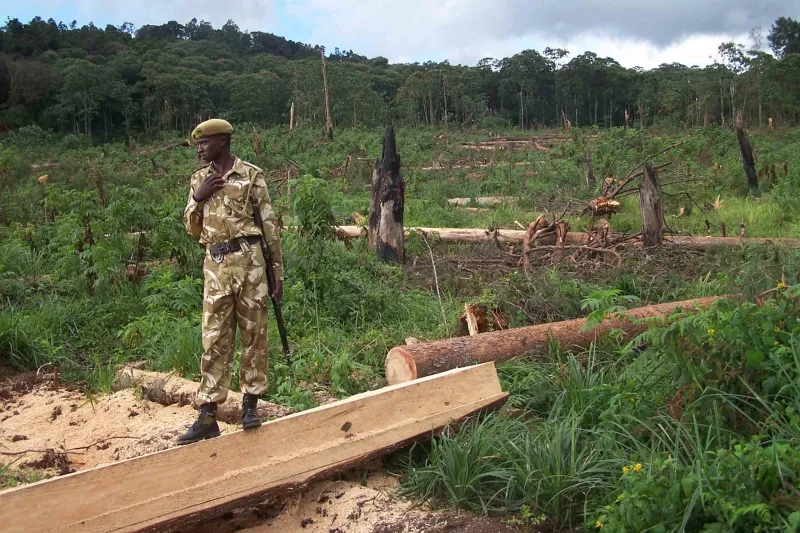
Forests are living ecosystems that thrive on balance, but when that balance is disrupted, they suffer, losing their ability to provide benefits on which people and economies depend. An estimated 489 million hectares of forest were lost between 1990 and 2025 through deforestation. Additionally, over 460 million hectares of forests are currently degraded worldwide, still standing but unhealthy and damaged. This degradation is caused by unsustainable use, urbanization, wildfires, pests, diseases, and climate change.
The consequences of forest degradation are profound, including disrupted food supplies, declining biodiversity, greater climate risks, and lost economic opportunities. In total, 1.56 billion hectares of land are now degraded worldwide, including forests, croplands, pasturelands, drylands, and wetlands. The gap between nature's capacity to provide and human needs keeps getting wider. To address these challenges, experts propose integrated forest and landscape restoration, which balances land conservation and economic production while improving people's lives and productivity.
Integrated forest and landscape restoration can bring damaged forests and landscapes back to life by planting trees, helping forests regenerate naturally, and improving land management. One approach is agroforestry, which involves growing and maintaining trees alongside crops and sometimes animals on the same land. This can transform how we tackle agriculture and food production, giving us a more stable climate, clean water, and richer soil, while creating sustainable and profitable businesses.
There is a strong economic case for restoration, as healthy ecosystems underpin more than half of the world's GDP, and well-designed restoration creates jobs and heals forests. Under the right conditions, every dollar spent on restoration can return as much as $30. The United Nations Decade on Ecosystem Restoration runs through 2030, and the knowledge, tools, and momentum are already in place. What remains is to use them at scale before the window closes.
Over the past two decades, national, regional, and global initiatives have pledged to bring more than one billion hectares of land under restoration. However, progress is not enough, as we currently have 206.5 million hectares of forest and landscape under restoration across 62 countries, falling short of the 470 million hectares needed to meet the world's 2030 goals. The State of the World's Forests 2026 report from the Food and Agriculture Organization of the United Nations provides guidance on how to achieve this goal.
Successful restoration projects are already underway, such as in Indonesia, where mangroves were restored in Demak, Northern Java, after being cleared for unsustainable fishing ponds and groundwater extraction. In southern Kenya, a community-led initiative is combining traditional knowledge with the low-cost half-moon method to revive native grasses and restore the Amboseli-Chyulu ecosystem. These examples demonstrate that restoration is not simply planting trees but bringing land back to health while making life better for people.
The Food and Agriculture Organization of the United Nations emphasizes the importance of involving people living and working on those lands, balancing nature with humanity's needs, finding sufficient funding, and putting the right policies, laws, and institutions in place. With the right approach, restoration can revitalize production systems, make the economy more resilient to future climate shocks, and provide numerous benefits for both people and the environment.
Key points
- The world's forests are in decline, and restoration is our greatest opportunity to address this challenge.
- Integrated forest and landscape restoration can bring damaged forests and landscapes back to life while improving people's lives and productivity.
- To meet the world's 2030 goals, we need 470 million hectares of land under restoration, but currently, we have only 206.5 million hectares across 62 countries.