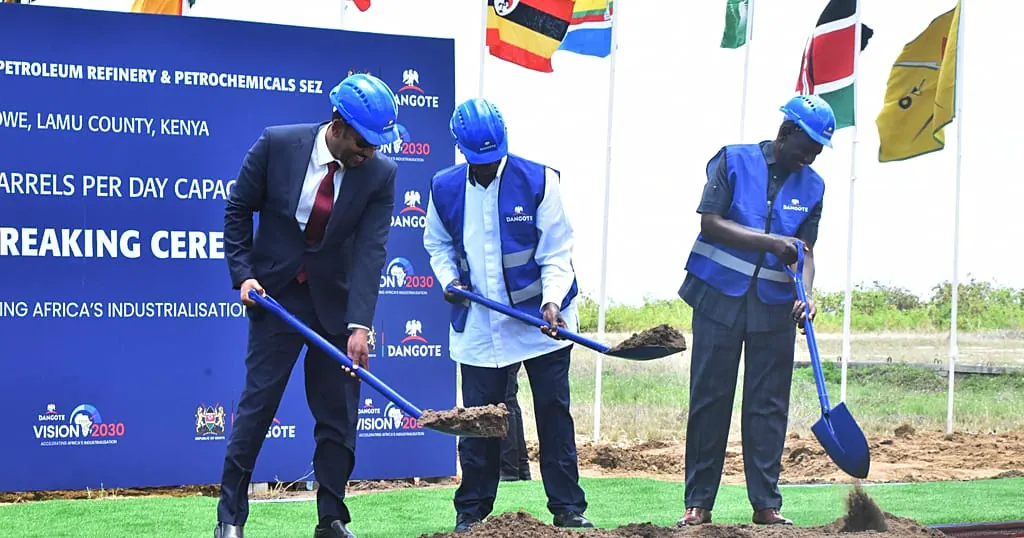
The picturesque Kenyan island of Lamu, a favourite of celebrities, faces a tough trade-off after becoming the construction site for Africa's latest mega-refinery. Lamu, on the Indian Ocean coast, is known for its 12th-century Old Town, traditional dhow sailing boats and paradisical beaches that have made it a favourite haunt of stars like Mick Jagger, Kate Moss and the Obamas.
Nigerian tycoon Aliko Dangote broke ground on the $16 billion venture on Wednesday alongside multiple heads of state in what is billed as Kenya's biggest-ever industrial project. The continent's richest man launched the Dangote Petroleum Refinery in Lamu, Kenya, on Sep. 30, 2026. For locals in Lamu — an island where cars are non-existent and transport still mostly happens by donkey — there has been little time to process the idea of having a massive fossil fuel complex on their doorstep.
The idea of building a Dangote refinery in east Africa was first mooted in April, and Lamu was chosen as the site only in July, while the company plans to have it operating by 2030. Some have already taken the project to court, fearing their land rights will not be respected, while environmental organisations including Greenpeace argue the refinery threatens to damage one of East Africa's most fragile coastal ecosystems.
Dozens gathered to protest in the Old Town on Tuesday, chanting "Haki Yetu" ("Our rights"). Dangote has dismissed the critics, describing those who oppose the refinery as "people who don't want the development of Africa". "Anybody who wants to cause trouble, we are ready for his trouble and will give him a headache," the billionaire said on Wednesday.
In his speech at the groundbreaking, Kenyan President William Ruto initially called those challenging the project in court "extortionists". But he then struck a more conciliatory tone, promising a rigorous environmental study and telling Lamu residents: "Your rights will be protected. Your voice will be heard."
Some locals told AFP this was too little, too late. "The study was to be conducted before the excavation and digging", not after, said local artist Salwa Mahmoud. "You don't negotiate after signing a contract. You negotiate before," added Khelef Khalifa, of the Muslims for Human Rights NGO. Many said they were excited by promises of 60,000 direct and indirect jobs from the refinery alongside a training centre for 1,000 young people.
Fishermen and tourism workers fear for their livelihoods. As a large turtle lumbered across the island's sands on Wednesday, tourism operator Famau said his sector supports 90 percent of the island. "Tourists come here for the culture," he said. "Not for the oil tankers."
Key points
- The Dangote Petroleum Refinery project has sparked fears of environmental damage and concerns over land rights among Lamu residents.
- The project promises 60,000 direct and indirect jobs and a training centre for 1,000 young people, but locals are sceptical about the benefits.
- Kenyan President William Ruto has promised a rigorous environmental study and protection of residents' rights, but some say it's too little, too late.