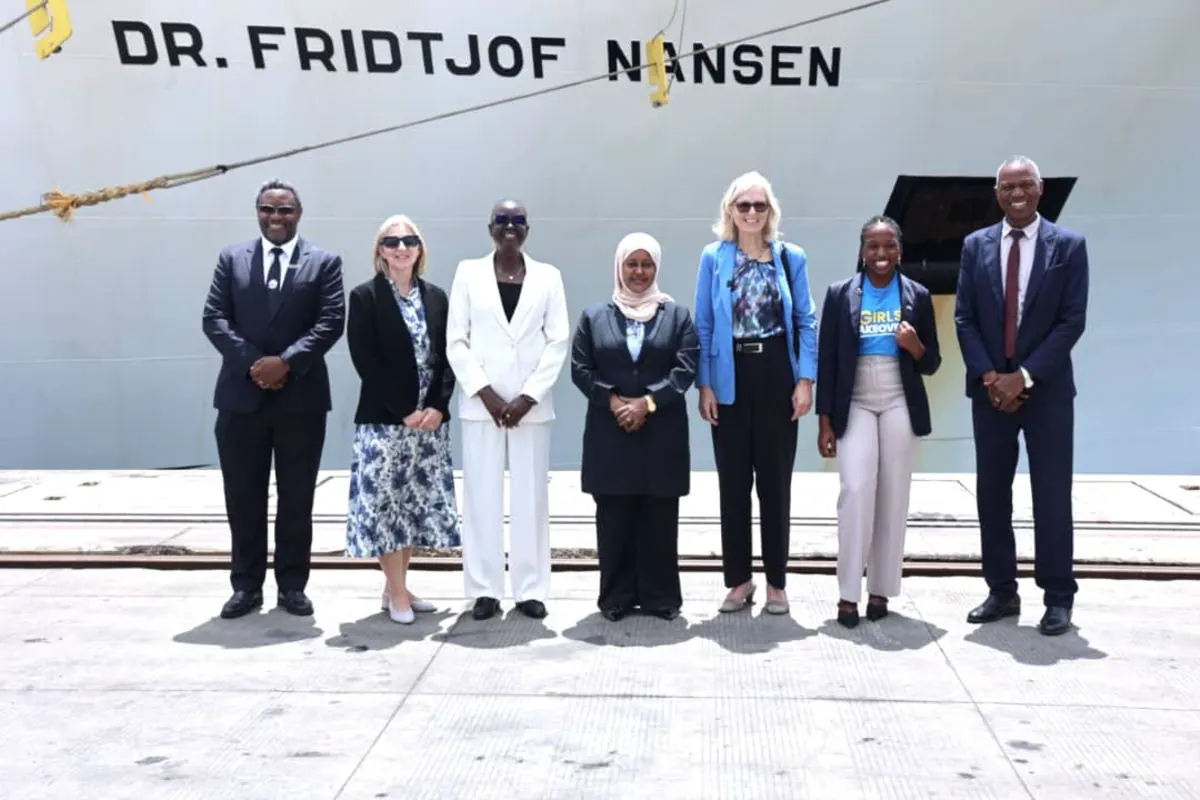
Researchers aboard the Dr Fridtj of Nansen, a Norwegian vessel, are collecting data from Tanzania's waters to help identify and protect valuable marine resources. The research, conducted in cooperation with the Food and Agriculture Organisation of the United Nations (FAO), aims to improve fisheries management and guide investment and other activities. The data will also help Tanzania unlock the potential of its blue economy. The research is examining fish abundance and distribution, water quality, aquatic plants, and climate-related conditions.
The Director General of the Tanzania Fisheries Research Institute (TAFIRI), Dr Ismael Kimirei, emphasized the importance of the research. He stated that decisions on the use of marine resources require a clear understanding of what exists in the country's waters and how those resources are changing. The research has many benefits, including understanding fisheries resources, different fish species, and biodiversity. The data collected will also be used in policy-making and Marine Spatial Planning.
The research has already generated significant findings. A survey conducted two years ago identified Kasukazini in the Mafia area as an important area for sharks. This information could support both conservation and tourism. Such findings can help authorities understand areas that require protection while also identifying marine assets that could have economic value. The research has also expanded scientific understanding of Tanzania's marine ecosystems.
The research has discovered coral gardens at depths much greater than previously known. A survey conducted last year found corals at depths of up to 400 metres, much deeper than the previously known 50 metres. These findings are significant for a country seeking to expand its blue economy. Sustainable use of marine resources depends on reliable information about their location, abundance, and condition.
The research programme is also building local scientific capacity. Researchers from TAFIRI, the Zanzibar Fisheries and Marine Resources Research Institute (ZAFIRI), the University of Dar es Salaam, a university in Zanzibar, and BioVision are participating in the programme. A Tanzanian researcher is serving as a co-cruise leader alongside a Norwegian scientist, demonstrating the programme's impact on building local expertise.
The Norwegian Ambassador to Tanzania, Ms Tone Tinnes, highlighted the importance of international cooperation in responding to challenges facing the ocean. She stated that climate change is increasingly affecting coastal ecosystems, fisheries, livelihoods, and ocean communities. The blue economy offers important opportunities for sustainable development, innovation, and economic activities. Tanzania-Norway cooperation covers climate adaptation, research, climate finance, and the sustainable blue economy.
The FAO Country Representative in Tanzania, Dr Nyabenyi Tipo, emphasized the value of the research information generated through the programme. She stated that the information is an asset for Tanzania that can be accessed by researchers to build further knowledge, including on climate resilience and mitigation. The research is also important for ocean governance, as the vessel collects information from deeper waters and within Tanzania's Exclusive Economic Zone.
Key points
- The research aims to improve fisheries management and guide investment in Tanzania's blue economy.
- The programme is building local scientific capacity through participation of Tanzanian researchers.
- The research has generated significant findings, including the discovery of coral gardens at great depths and identification of important areas for sharks.