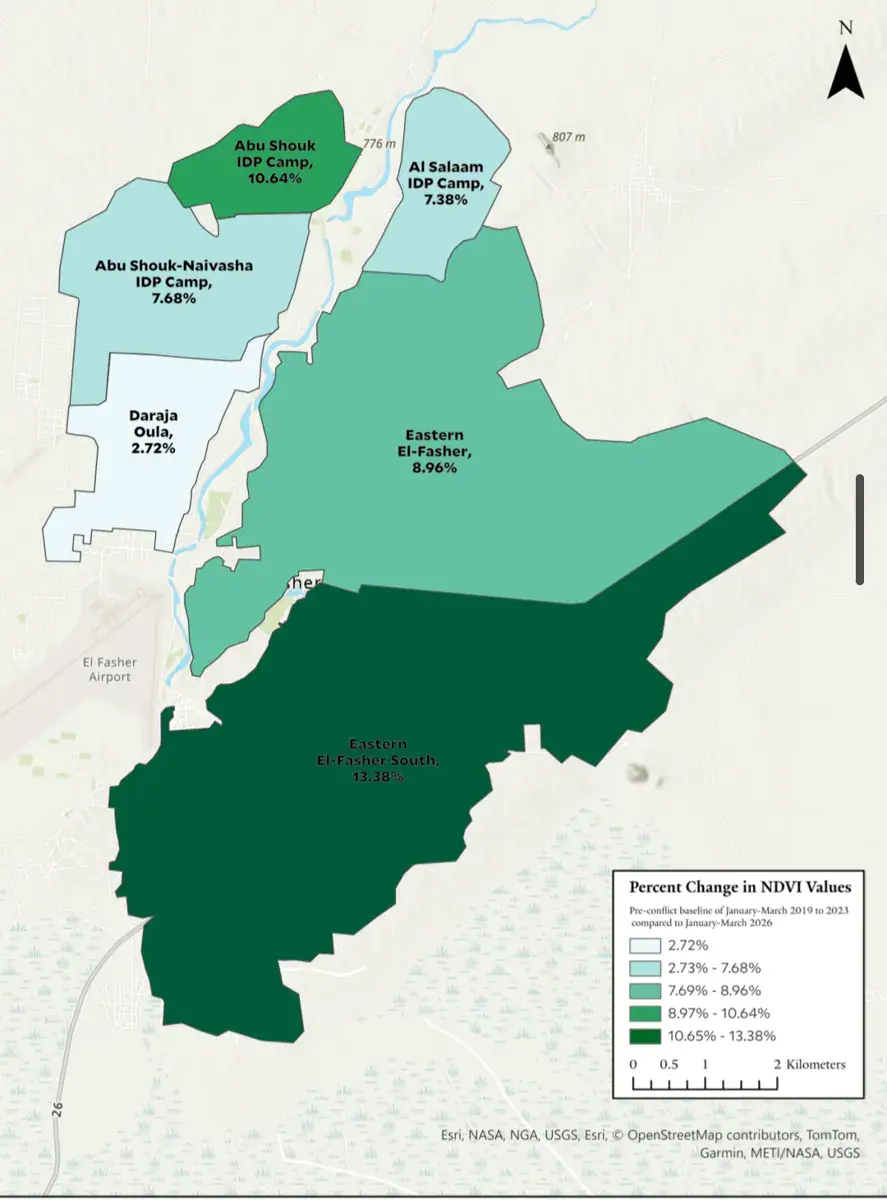
A report by the Human Research Laboratory at Yale University's School of Public Health has revealed that Fashir, a city in Sudan, has been transformed into a "ghost city" after a year of conflict. The report, released on October 28, 2026, states that the city has been largely abandoned, with its original population and displaced persons fleeing due to a 20-month siege and subsequent campaign of bombardment, starvation, and mass killings.
Before the siege began in April 2024, the greater Fashir area, including refugee camps, was estimated to have a population of 1-2 million people, comparable to global cities like Amsterdam, Birmingham, and Tripoli. However, the conflict has led to a significant decline in population, with the city now largely deserted. The report used satellite imagery to assess the city's transformation, finding a 9.02% increase in vegetation growth, indicating a lack of human activity.
The report analyzed nine main markets in Fashir, comparing satellite images from September 2026 to those taken before the siege in November 2023. The images showed a complete lack of human activity, vehicle movement, and animal presence in eight of the nine markets. The central market in the first-degree neighborhood was the only one that showed signs of activity, with new tents and vehicle movement, indicating it as the operational center for the Rapid Support Forces (RSF) and remaining civilians.
The report also evaluated the state of healthcare facilities in Fashir, tracking 19 facilities across the city. Satellite images showed no signs of crowds, organized ambulance movement, or maintenance and reconstruction efforts at these facilities. The report revealed that five major hospitals had been used for digging and burning activities, with evidence of human remains being incinerated.
The RSF has been accused of creating a physical barrier around the city, constructing a 75-kilometer trench and earthen barrier to prevent civilians from leaving or humanitarian aid from entering. The report documented the use of barriers and traffic mazes at four main entry points, making it difficult for people to move in or out of the city. This has led to a severe humanitarian crisis, with the city experiencing extreme famine conditions.
The report also examined the state of water infrastructure in Fashir, finding that the main water station had been damaged by bombardment, with evidence of water leaks and the presence of armed RSF vehicles. The report concluded that the city's water supply has been severely compromised, exacerbating the humanitarian crisis.
The Yale University report concludes that Fashir has been the scene of war crimes, crimes against humanity, and acts with "genocidal characteristics." The report calls for an international investigation, urging the International Criminal Court and human rights organizations to be granted free and unconditional access to collect remaining evidence before it is destroyed.
Key points
- The conflict in Fashir has resulted in a significant decline in population, with the city now largely deserted.
- The report revealed that the RSF has been responsible for the destruction of healthcare facilities and the killing of civilians.
- The international community has been criticized for not taking decisive action to protect civilians in Fashir despite early warnings of the impending humanitarian crisis.