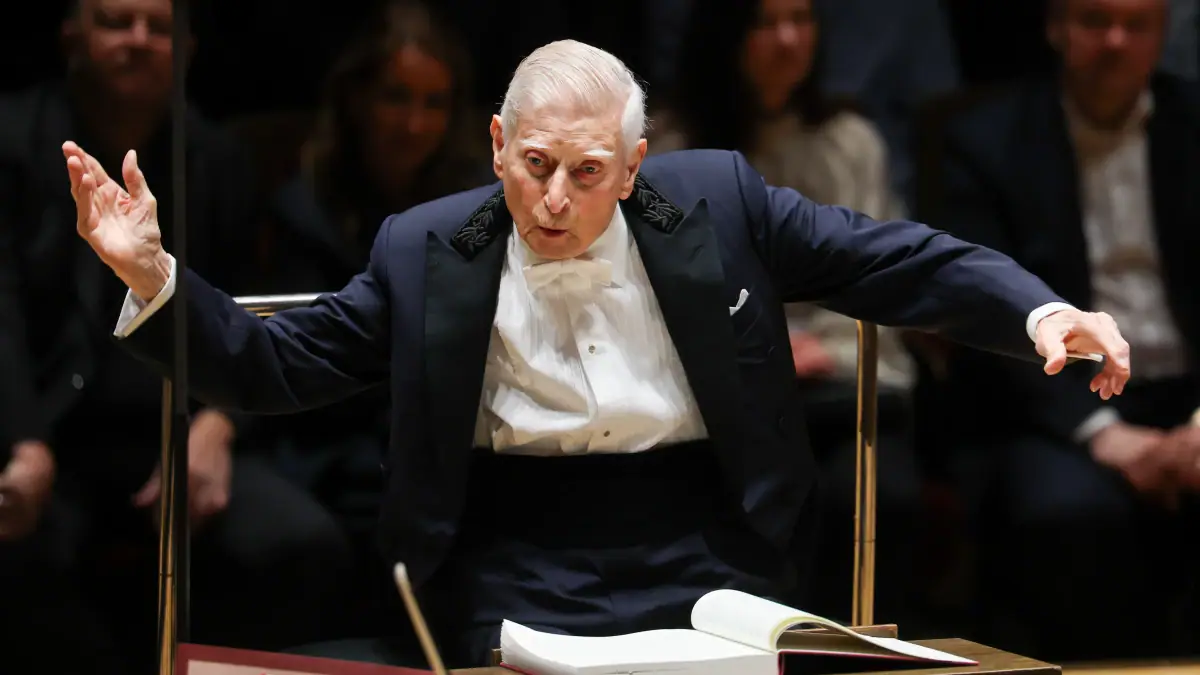
Herbert Blomstedt, an American-born, Swedish conductor, died on Wednesday at his home in Gothenburg, Sweden, at the age of 99. His death was announced by his management company, KünstlerSekretariat am Gasteig. Blomstedt had a remarkably long career, leading many of the world's major orchestras, including the San Francisco Symphony, which he directed for 10 years. He worked into his late 90s, conducting concerts with the Detroit Symphony and the Gewandhaus Orchestra of Leipzig, Germany, this year.
Blomstedt was known for his clear-eyed structural integrity and strict devotion to the composer's score, bringing a distinctive spiritual power to his performances. He recorded all nine Beethoven symphonies twice, once with the Staatskapelle Dresden and later with the Gewandhaus Orchestra of Leipzig. His interpretations of Beethoven's music were marked by a merciful empathy and a focus on the humanity in the composer's work. Blomstedt pointed to the suffering in Beethoven's music as a key to its enduring power.
Born on July 11, 1927, in Springfield, Mass., to Swedish parents, Blomstedt learned piano, violin, and organ in his youth. He fell in love with symphonic music and memorized the names of orchestra players. The young Blomstedt asked the revered German conductor Wilhelm Furtwängler for an autograph when he performed in Gothenburg. Blomstedt entered the Swedish Royal College of Music in 1945, studying conducting under influential figures such as John Cage, Igor Markevitch, and Leonard Bernstein.
Blomstedt's formal conducting debut came in 1954 with the Stockholm Philharmonic, moving directly to his first professional post with the Swedish Norrköping Symphony Orchestra. He had close relationships with dozens of orchestras around the world, including the San Francisco Symphony, which he led as music director from 1985 to 1995. During his tenure, the San Francisco Symphony began to tour internationally and record, developments that were closely tied to Blomstedt's leadership.
Blomstedt returned to lead the San Francisco Symphony in 2003, and his performances were met with critical acclaim. However, his approach to conducting was not without criticism, with some reviewers finding his interpretations too rational and cautious. Despite this, Blomstedt remained committed to his artistic vision, believing that music could be a powerful ethical force in society. He saw great music as a way to bring listeners into contact with something greater than themselves.
Throughout his life, Blomstedt was guided by his devout Seventh-day Adventist faith, which influenced his approach to music and his personal habits. He eschewed alcohol, coffee, tobacco, and meat, and initially refused to rehearse on Saturdays, when he observed the sabbath. Although this sometimes cost him jobs, Blomstedt remained committed to his values, rationalizing that the real work had been done in rehearsal.
Blomstedt's legacy as a conductor is marked by his tireless dedication to music and his ability to elicit ecstatic performances from his orchestras. Despite health concerns and personal setbacks, he continued to conduct well into his 90s, leaving behind a body of work that will be remembered for generations to come. His passing has been met with tributes from the music world, honoring a life devoted to the pursuit of beauty and perfection.
Key points
- Herbert Blomstedt conducted his final concerts with the San Francisco Symphony in May of this year and had planned to conduct again in January 2027, but both were canceled due to health concerns.