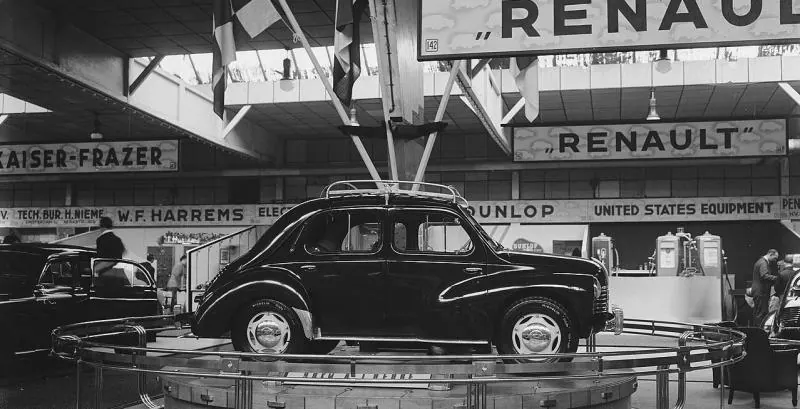
Renault's 4CV model, introduced 80 years ago, has become an iconic symbol of France's post-war automotive industry. Developed in secret during World War II by engineers Fernand Picard and Edmond Serre, the 4CV was designed to be an affordable vehicle for the masses. The model's launch at the 1946 Paris Motor Show marked a significant milestone in France's industrial revival. With its lightweight design and rear-mounted engine, the 4CV offered a unique solution to the country's transportation needs.
The 4CV's production began in August 1947, with the first 300 units allocated to dealerships for promotional purposes. Initially, only 15 units were produced per week, but demand quickly surged, and production increased to 6,327 units in 1947, 29,917 in 1948, and 63,920 in 1949. The 4CV's popularity was fueled by its affordability and innovative design, which included a rear-mounted engine and a lightweight body. The model's success was hailed as a "miracle" by the French press, with many praising its ability to make car ownership accessible to a wider audience.
By the early 1950s, the 4CV had become an integral part of French culture, with its rounded shape and cream-colored design earning it the nickname "Motte de beurre." The model's success was accompanied by regular technical updates, including a 747 cm³ engine with 21 horsepower in 1951 and new telescopic shock absorbers in 1952. A convertible version and a utility vehicle, the 4CV Service, were also introduced. The 4CV's impact on French society was significant, with the vehicle becoming a status symbol for the working class and a staple of urban landscapes.
The 4CV's versatility and reliability made it a popular choice for various uses, from daily commutes to long-distance travel. In 1950, a 4CV was used to complete a 500 km journey from Paris to Geneva at an average speed of 91 km/h. The model's performance capabilities were further enhanced by engine tuning, which allowed owners to increase the vehicle's power output. The 4CV's widespread adoption also led to its use in various industries, including banking and finance.
The 4CV's impact on French society extended beyond its practical uses, with the vehicle becoming a cultural icon of the post-war era. In 1951, a 4CV was used in a high-profile heist in Paris, with thieves making off with 18 million francs. The model's popularity also led to its use as a promotional item, with the Bourgogne républicaine newspaper offering a 4CV as a prize for its readers in 1950.
In April 1954, Renault celebrated the production of the 500,000th 4CV, a milestone that marked the model's status as a bestseller in France. To coincide with this achievement, Renault introduced a new front-end design for the 4CV, featuring the iconic "moustaches" that became a hallmark of the model. The 4CV continued to dominate the French market, with the vehicle being named the best-selling car in France in 1954 and 1955.
The 4CV's legacy extends beyond its commercial success, with the vehicle playing a significant role in democratizing car ownership in France. The model's affordability and accessibility made it possible for ordinary citizens to own a vehicle, transforming the country's transportation landscape. Today, the 4CV remains an iconic symbol of French automotive history, with its innovative design and cultural significance continuing to inspire new generations of car enthusiasts.
Key points
- The Renault 4CV was a groundbreaking vehicle that revolutionized France's post-war automotive industry with its affordability and innovative design.
- The 4CV's success was fueled by its popularity among the working class, with the vehicle becoming a status symbol for ordinary citizens.
- The 4CV's legacy extends beyond its commercial success, with the vehicle playing a significant role in democratizing car ownership in France.