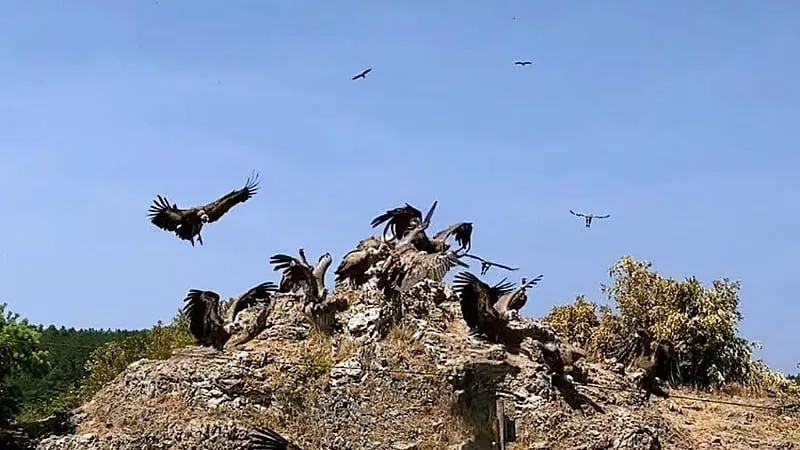
The reintroduction of vultures to France has been a conservation success story, with over 1,200 breeding pairs of griffon vultures now present in the Grands Causses region. The League for the Protection of Birds (LPO) has been working with farmers to provide feeding sites for the vultures, collecting sheep carcasses three times a week and bringing them to designated areas. This effort has helped to revive the vulture population, which had dwindled to almost nothing by the 1940s due to persecution and poisoning.
Despite the success of the reintroduction program, tensions have arisen between conservationists and farmers. One issue is the attraction of vultures to water troughs provided for sheep, which can lead to the animals refusing to drink from them. To address this problem, the LPO has worked with farmers to introduce solutions such as floating covers to make the troughs less appealing to vultures. This is an important consideration, as the vulture population continues to grow and interact with farm animals.
Another point of friction is the report of vultures attacking live animals, which has led to concerns among farmers. However, according to Lilia Damian of the LPO, the vast majority of cases investigated have found that the animals were already dead when the vultures arrived. In some cases, vultures may have accompanied or worsened the decline of weak animals, but they did not cause the deaths. The LPO is working to educate farmers about the role of vultures and the circumstances of these incidents.
The reintroduction of vultures to France has not been uniformly successful across all species. While griffon vultures have thrived, with over 1,200 breeding pairs present, other species have had less success. There are fewer than 40 breeding pairs of black vultures, three breeding pairs of Egyptian vultures, and no breeding pairs of bearded vultures. Each species has different feeding habits, with griffon vultures eating soft tissue and black vultures consuming skin and tendons.
Robert Straughan, vulture project director for the LPO, has observed the vultures' behavior firsthand. He notes that the birds are highly social and will often feed together in large groups, with dozens of individuals descending on a carcass at once. Straughan also highlights the importance of understanding the ecological role of vultures, which help to clean up carcasses and prevent the spread of disease.
The LPO's work with farmers has helped to build trust and cooperation, with some farmers actively working with the organization to provide feeding sites and monitor vulture activity. By collecting carcasses and providing them to the vultures, farmers are helping to support the conservation effort while also reducing the risk of disease transmission. This collaboration is essential for the long-term success of the reintroduction program.
As the vulture population continues to grow, it is likely that interactions with farmers and their animals will remain a challenge. However, by working together and finding solutions to common problems, conservationists and farmers can coexist and promote the health of both the vulture population and the agricultural industry. The reintroduction of vultures to France serves as a model for conservation efforts elsewhere, highlighting the importance of collaboration and education in achieving successful outcomes.
Key points
- The reintroduction of vultures to France has caused tension with farmers, who report issues with water use and attacks on live animals.
- The LPO is working with farmers to address these concerns and promote coexistence with vultures.
- The reintroduction program has been successful for griffon vultures, but other species have had less success.