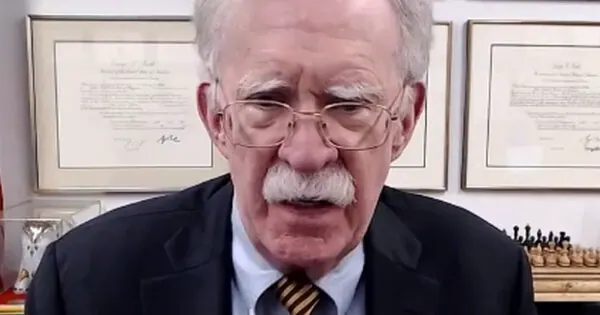
Former US National Security Advisor John Bolton has emphasized that peace and security in the Middle East, as well as the success of the India-Middle East-Europe Economic Corridor (IMEC), hinge on a regime change in Iran. The IMEC, launched in 2023, aims to connect India, the Middle East, and Europe through a network of trade routes. Bolton praised the economic potential of the corridor but expressed concerns about the security threats posed by Iran. He noted that stability in international trade corridors cannot be achieved under the current Iranian leadership.
The IMEC comprises an Eastern Corridor linking India to the Gulf region and a Northern Corridor connecting the Gulf region to Europe. This ambitious project includes a railway and ship-rail transit network, as well as road transport routes. According to Bolton, closer ties between India, West Asia, and Europe represent a logical strategic evolution. However, he stressed that the regime in Tehran poses significant security threats, jeopardizing commercial transit across key maritime choke points, such as the Strait of Hormuz and the Bab al-Mandab Strait.
Bolton criticized US President Donald Trump's handling of international issues, stating that his administration lacks a coherent regional strategy and addresses geopolitical issues in isolation. Trump has endorsed the IMEC initiative, but Bolton argued that the President's approach to Iran is contradictory and lacks a long-term plan. He noted that Trump's recent address at the 81st session of the United Nations General Assembly primarily served as a pitch to domestic voters ahead of the upcoming US elections, rather than a genuine attempt to address the Iranian issue.
During his address at the UN General Assembly, Trump stated that his administration strongly supports the IMEC corridor, emphasizing the need to shift Middle East energy infrastructure away from Iranian checkpoints. He cited multiple strikes on West Asian countries during the war as a reason for this shift. Bolton countered that Trump's rhetoric attempts to balance military threats with economic promises to reassure voters about global energy prices. However, he concluded that Trump's stance toward Tehran is inconsistent, oscillating between threats of annihilation and offers to make a deal.
Bolton expressed skepticism about Trump's ability to develop a coherent strategy for Iran, stating that the President is "all over the place" and lacks a real plan. He argued that Trump's speech at the UN General Assembly was tailored to appeal to American voters, rather than foreign governments. The former US NSA emphasized that a regime change in Iran is essential for achieving peace and security in the region and ensuring the success of the IMEC corridor.
The IMEC corridor has the potential to significantly enhance economic cooperation between India, the Middle East, and Europe. However, its success depends on the stability and security of the region. Bolton's comments highlight the challenges posed by Iran's current regime and the need for a more comprehensive approach to addressing these challenges. The international community continues to grapple with the complexities of the Iranian issue and its implications for regional peace and security.
In conclusion, the IMEC corridor and regional peace are inextricably linked to the issue of Iranian regime change. As the international community moves forward, it will be essential to address the security threats posed by Iran and develop a coherent strategy for promoting stability in the region. The success of the IMEC corridor and the broader goals of regional peace and security depend on a coordinated and effective approach to this complex challenge.
Key points
- Former US NSA John Bolton emphasizes that peace and security in the Middle East and the success of the IMEC corridor depend on a regime change in Iran.