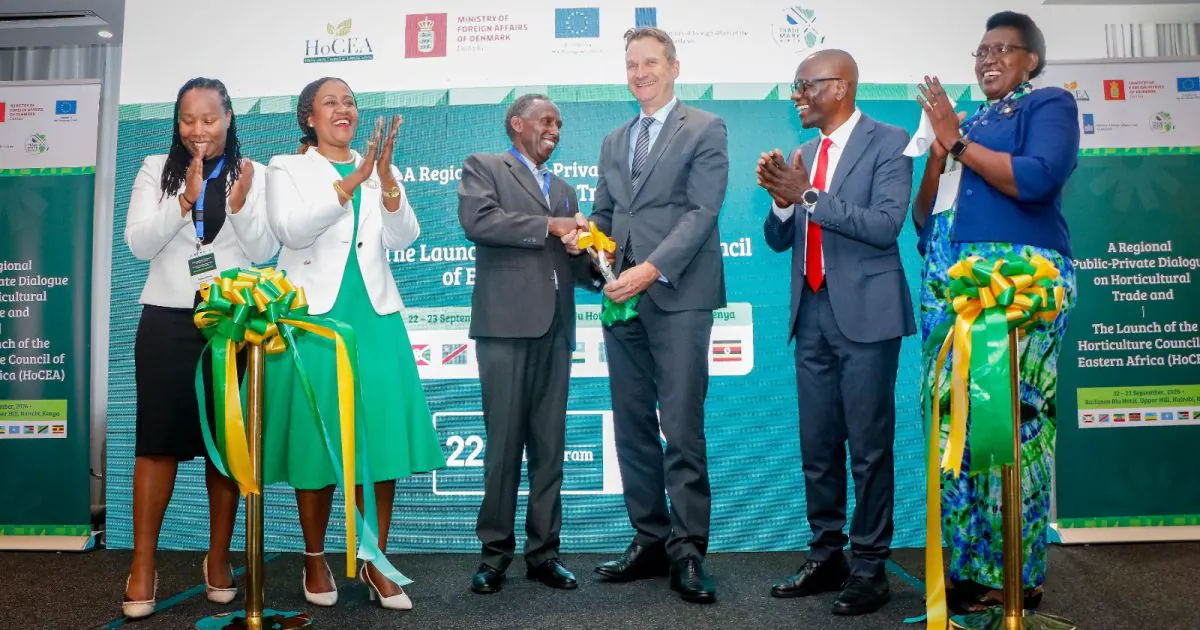
Eastern African countries have been urged to strengthen regional cooperation to address high logistics costs, trade barriers and fragmented cold-chain systems holding back the horticulture sector. The Principal Secretary for Trade, Regina Akoth Ombam, emphasized the need for coordinated action to boost productivity, deepen regional value chains and retain more value from processing, packaging and branding within Eastern Africa. This call was made during the Regional Public-Private Dialogue and official launch of the Horticulture Council of Eastern Africa (HoCEA) in Nairobi, Kenya.
The horticulture sector in Eastern Africa faces common challenges, including high logistics and cold-chain costs, lengthy border procedures, sanitary and phytosanitary requirements, non-tariff barriers and limited digital integration. In 2025, Kenya exported about 457,700 tonnes of horticultural produce valued at Sh143.78 billion. However, the region's ambition should go beyond export volumes to increasing productivity, value addition, and market diversification. The sector requires a coordinated approach to overcome these challenges and unlock its full potential.
The Horticulture Council for Eastern Africa (HoCEA) Secretary General, Clement Tulezi, noted that the challenges facing producers and exporters are increasingly regional and can no longer be effectively addressed through national responses alone. He cited high freight costs, fragmented cold chains, non-tariff barriers, inconsistent border procedures, changing sanitary and phytosanitary requirements, limited cargo capacity and post-harvest losses as some of the challenges confronting the industry. The Council will focus on addressing cross-border challenges while national associations handle country-specific priorities.
HoCEA's immediate priorities include establishing a mechanism to identify and escalate horticultural trade barriers, pursuing fast-track arrangements for compliant perishable cargo, developing a regional logistics and cold-chain agenda and advancing SPS harmonization and digital certification. The Council will also develop an African Continental Free Trade Area (AfCFTA) market-access programme aimed at helping horticultural enterprises move from understanding the continental trade agreement to actually trading under its preferential arrangements.
The Netherlands Ambassador to Kenya, Jan Bakker, highlighted the importance of the horticulture sector in Kenya, generating about Sh193 billion (€1.3 billion) annually in exports and providing more than 250,000 direct jobs and 3.5 million indirect jobs. The Netherlands is working with Kenya, Uganda, and Rwanda under the Fostering Resilient Exports in Sustainable Horticulture (FRESH) programme to strengthen horticultural exports through investment in cold-chain infrastructure, trade facilitation and digital systems.
The FRESH programme, co-financed by the European Union and the Netherlands, seeks to promote more efficient transport of fresh produce, including increased use of sea freight and multimodal logistics. Ambassador Bakker called for stronger public-private cooperation, saying policy predictability and consistent implementation are critical to attracting investment and expanding horticultural trade. He congratulated the organizers on the establishment of the Horticulture Council of East Africa (HOCEA), saying the regional platform would provide an opportunity to address challenges facing the horticulture sector.
HoCEA Chairperson, Dr. Jacqueline Mkindi, said the Council would seek to strengthen the regional private sector voice, while promoting farmers' access to markets, finance, technology, knowledge and value-addition opportunities. The regional body was established to transform Eastern Africa's horticulture sector from fragmented national efforts into a coordinated production, processing and trading ecosystem, capable of competing in regional and global markets. The Council brings together the horticulture industry across nine Eastern African countries and seeks to strengthen regional coordination in trade facilitation, logistics, digital systems, value chains and sustainability.
Key points
- Eastern African countries urged to strengthen regional cooperation to address high logistics costs, trade barriers and fragmented cold-chain systems.
- HoCEA to focus on addressing cross-border challenges while national associations handle country-specific priorities.
- The Netherlands working with Kenya, Uganda, and Rwanda to strengthen horticultural exports under the FRESH programme.