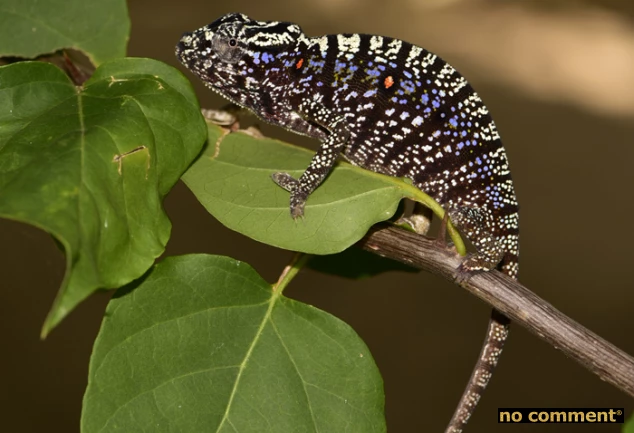
A team from the Zoological State Collection Munich (ZSM) has successfully located the Voeltzkow's chameleon (Furcifer voeltzkowi), a species that had been lost to sight since 1913. This remarkable find was announced in the scientific journal Salamandra, following an expedition in April 2018 to northwest Madagascar. The team, led by Dr. Frank Glaw, comprised German and Malagasy researchers who had been searching for this elusive creature for years.
The Voeltzkow's chameleon, first described by Alfred Voeltzkow in 1893, is one of approximately 500 terrestrial vertebrates that are severely threatened and may become extinct within two decades. This species, characterized by its vibrant colors, belongs to the 96 chameleon species endemic to Madagascar. The rediscovery was met with excitement, as it provides new insights into the species' behavior, habitat, and conservation status.
During the expedition, the team discovered a female Voeltzkow's chameleon, whose coloration and morphology were previously unknown. According to Dr. Glaw, the female chameleons exhibit bright colors, including violet, orange, red, green, black, and white, with distinctive patterns. These colors can change depending on their mood, particularly when they encounter males or are pregnant. This new information highlights the unique characteristics of the female Voeltzkow's chameleon.
The researchers believe that Furcifer voeltzkowi has a relatively short lifespan, likely living only a few months during the rainy season. This limited timeframe makes it challenging to detect the species, as it requires being in the right location at the right time. The team's success was largely due to the expertise of Angeluc Razafimanantsoa, a professional guide from the Montagne d'Ambre region, who was the first to spot the chameleons.
A total of three males and nearly 15 females were discovered during the expedition. Initially, scientists thought that the Voeltzkow's chameleon had a similar life cycle to its close relative, Furcifer labordi, which lives for only four to five months. However, genetic analysis confirmed that Voeltzkow's chameleon is a distinct species. While it is not currently considered threatened with extinction, its habitat is under threat due to deforestation and bushfires.
Conservation efforts are underway to protect the Voeltzkow's chameleon and its habitat. Some potential habitats are already safeguarded within nature reserves, and further research will inform additional conservation measures. The rediscovery of this species brings attention to the importance of preserving Madagascar's unique biodiversity. Global Wildlife Conservation has also confirmed the rediscovery of five other species on its list of 25 lost species.
The successful expedition to rediscover the Voeltzkow's chameleon highlights the importance of continued exploration and research into Madagascar's diverse wildlife. As one of the 96 chameleon species endemic to the island, Furcifer voeltzkowi serves as a symbol of the country's unique and threatened biodiversity. Efforts to conserve this species and its habitat will contribute to the protection of Madagascar's rich natural heritage.
Key points
- The Voeltzkow's chameleon was rediscovered in northwest Madagascar after 107 years, providing new insights into its behavior, habitat, and conservation status.
- The species exhibits unique characteristics, including vibrant colors and a relatively short lifespan during the rainy season.
- Conservation efforts are underway to protect the Voeltzkow's chameleon and its habitat, including the establishment of nature reserves and further research into its distribution and ecology.