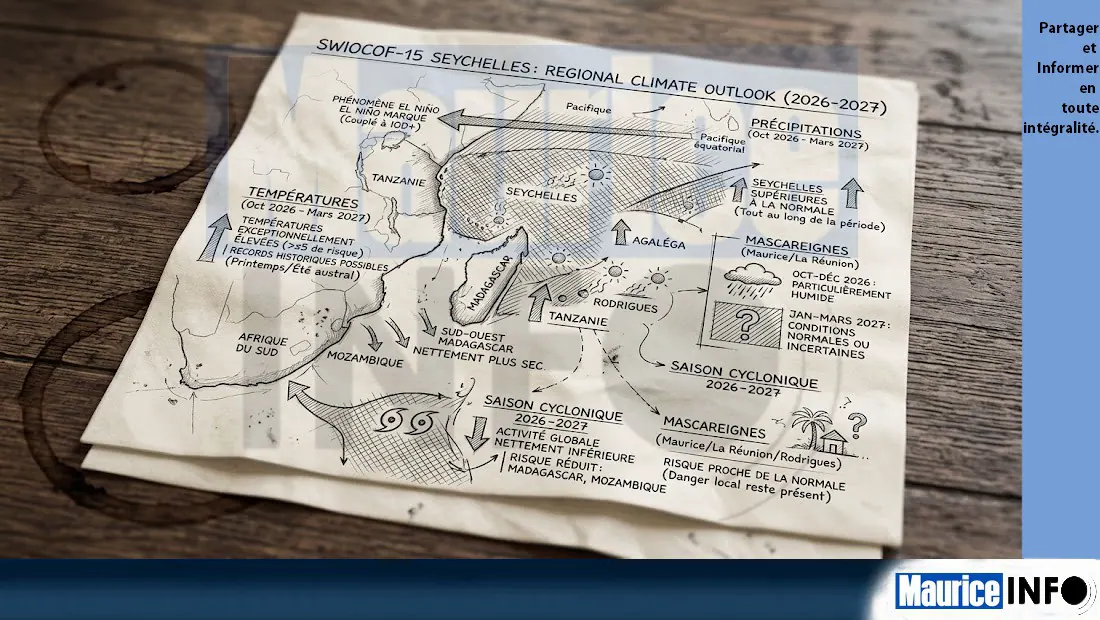
The Southwest Indian Ocean region is expected to experience record-high temperatures and varied precipitation patterns during the 2026-2027 summer season. According to experts gathered at the 15th Seychelles Workshop on the Southwest Indian Ocean Climate Outlook Forum (SWIOCOF-15), the region will be influenced by a strong El Niño event and a positive Indian Ocean Dipole (IOD). These global atmospheric and oceanic conditions will significantly impact regional weather patterns over the next few months.
The El Niño event and positive IOD will lead to exceptionally high temperatures across the region from October 2026 to March 2027. Temperatures are already above normal at the end of the dry season and are expected to continue rising. Specialists at SWIOCOF warn that the risk of experiencing exceptionally elevated temperatures is more than five times higher than usual, potentially breaking historical heat records in several countries and territories during the austral spring and summer.
In terms of precipitation, the region can expect varied patterns. Mauritius and Réunion are likely to experience a particularly wet start to the season between October and December 2026, followed by normal or uncertain conditions in the first quarter of 2027. Rodrigues, Agaléga, the Seychelles, and Tanzania are expected to receive above-normal rainfall throughout the period. Conversely, southwest Madagascar, as well as parts of Mozambique and South Africa, are anticipated to experience significantly drier conditions.
The 2026-2027 cyclone season in the Southwest Indian Ocean is expected to be less active than usual. Under the influence of El Niño, most tropical systems will likely move southward, reducing the risk of direct impact for Madagascar and Mozambique. However, the risk of cyclone impact remains near normal for the Mascarene archipelago, which includes Mauritius, Réunion, and Rodrigues.
The SWIOCOF experts emphasized that a below-average cyclone season does not necessarily mean a complete absence of local danger. The regional climate outlook is based on the latest available data and is intended to inform decision-making in various sectors, including agriculture, water resources, and disaster risk management.
The climate outlook for the Southwest Indian Ocean region is closely monitored by various stakeholders, including national meteorological services, regional organizations, and international partners. The SWIOCOF-15 forum provided a platform for experts to share knowledge, discuss regional climate variability, and develop strategies for mitigating the impacts of climate-related hazards.
As the 2026-2027 summer season approaches, residents and authorities in the Southwest Indian Ocean region are advised to stay informed about the latest climate forecasts and warnings. By taking proactive measures to prepare for potential climate-related hazards, communities can reduce the risks associated with extreme weather events and promote sustainable development.
Key points
- Record-high temperatures are expected in the Southwest Indian Ocean region during the 2026-2027 summer season.
- Varied precipitation patterns will impact different parts of the region, with some areas experiencing heavy rainfall and others facing drier conditions.
- The 2026-2027 cyclone season is expected to be less active than usual, but the risk of cyclone impact remains near normal for the Mascarene archipelago.