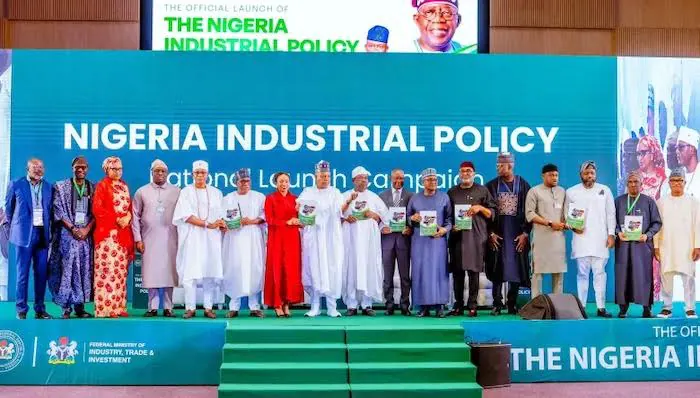
Seven months into the implementation of the 2025 Nigeria Industrial Policy (NIP), stakeholders in the Nigerian industrial sector are identifying ways to realise its objectives. The policy has been hailed as a strategically designed document to boost industrial productivity, enhance global competitiveness of Nigerian manufacturers, and drive massive job creation. The Manufacturers Association of Nigeria (MAN) has expressed support for the policy, saying it will engender a focused and coordinated industrial development for the country.
However, the Manufacturers Association of Nigeria (MAN) stated that the success of the NIP would depend on actionable and measurable steps that would address the binding constraints hindering the competitiveness of the country’s industrial sector. These constraints include credit crunch to the industrial sector, high energy cost, and unreliable supply of electricity, and shortage of foreign exchange for industrialists to import raw materials and machineries. The association expressed concern that high cost of credit to the industrial sector could paralyse the NIP.
MAN noted that a sweeping industrial policy is entirely dependent on a functional financial transmission mechanism, adding that if the banking ecosystem maintains severe risk aversion and prohibitively high lending rates, the promised capital cannot flow from government blueprints to the factory floor. The association said that credit to its members as at May 2026 remained exploitatively high at an average of 27 per cent prime lending rates and 35.6 per cent maximum lending rates in major commercial banks. This has created an environment where borrowing for long-term manufacturing capital expenditure is financially unviable.
To address this challenge, MAN called on the Central Bank of Nigeria (CBN) to further reduce the Monetary Policy Rate (MPR) to below 20 per cent, especially for manufacturers. The association stated that a persistent credit squeeze can directly sabotage the successful execution of the 2025 Nigeria Industrial Policy (NIP). Without accessible, single-digit credit that supports domestic manufacturers to execute capital expenditures and modernising operations, the NIP’s ambitious targets for economic diversification and industrial revitalisation become practically unfunded and unrealisable mandates.
In addition to addressing the credit challenge, MAN tasked the government to pass the NIP as an Act of Parliament to make targets and incentives legally binding, and to prevent arbitrary changes or abandonment by future administrations. This, the association said, will provide a long-term framework for industrial development in Nigeria. The association also called for the integration of the Bureau of Public Procurement (BPP) portal with a local content registry.
Furthermore, MAN suggested that budget releases to MDAs should be automatically blocked if they fail to meet a 60 per cent local procurement target. This, the association said, will encourage local content and promote the development of the Nigerian industrial sector. The association's recommendations are aimed at ensuring that the NIP achieves its objectives and leads to sustainable industrial development in Nigeria.
The implementation of the NIP has the potential to transform Nigeria's industrial sector and drive economic growth. However, stakeholders must work together to address the challenges facing the sector, including high credit costs, unreliable electricity supply, and shortage of foreign exchange. With a coordinated effort, Nigeria can achieve its industrial development goals and become a major player in the global economy.
Key points
- The Manufacturers Association of Nigeria (MAN) has expressed support for the 2025 Nigeria Industrial Policy (NIP), but noted that its success depends on addressing the binding constraints hindering the competitiveness of the country’s industrial sector.
- The association called on the Central Bank of Nigeria (CBN) to further reduce the Monetary Policy Rate (MPR) to below 20 per cent, especially for manufacturers.
- MAN tasked the government to pass the NIP as an Act of Parliament to make targets and incentives legally binding, and to prevent arbitrary changes or abandonment by future administrations.