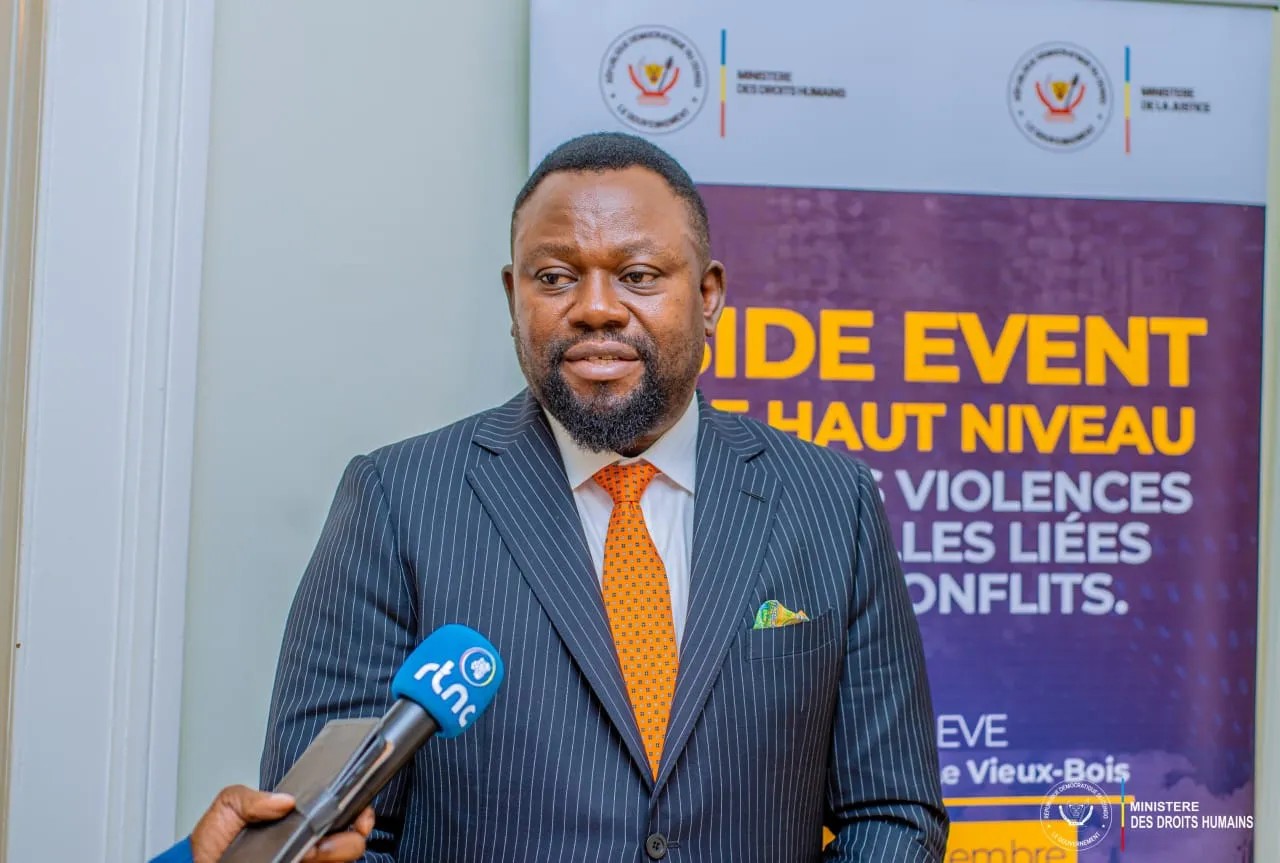
The Democratic Republic of Congo (DRC) has assumed the presidency of the International Alliance to Prevent Sexual Violence in Conflict (PSVI) in 2026, with a focus on enhancing global efforts to combat these crimes. According to the DRC's Minister of Human Rights, Samuel Mbemba Kabuya, the country's experience with nearly three decades of conflict has provided valuable insight into the issue. The minister emphasized that the DRC's presidency aims to translate political commitments into concrete actions.
The PSVI was launched in 2012 by the United Kingdom, with the support of Angelina Jolie, then the Special Envoy of the UN High Commissioner for Refugees. The alliance is built on the principle that conflict-related sexual violence is preventable, documentable, and punishable. During a high-level event at the 63rd session of the Human Rights Council in Geneva, Minister Mbemba Kabuya called on ambassadors, international organization representatives, and civil society members to give a voice to those affected by these crimes.
The DRC has outlined three priorities for its presidency of the PSVI: strengthening the alliance, combating impunity, and protecting children born of conflict-related rape. To strengthen the alliance, the DRC proposes establishing a permanent global secretariat to ensure continuity, monitor commitments, and coordinate efforts. The minister also urged states that have not yet joined the alliance to participate and encouraged current members to designate a national focal point and make measurable commitments.
Combating impunity is another key priority for the DRC's presidency. The country aims to promote the reinforcement of national legislation and the training of judges, police officers, and military personnel. The DRC also advocates for the systematic use of the International Protocol on Documentation and Investigation to gather evidence for judicial proceedings. This is particularly crucial in the DRC, where conflict-related sexual violence remains a significant challenge.
Protecting children born of conflict-related rape is the third axis of the DRC's action. These children are often stigmatized, rejected, or excluded, and may face a second condemnation. The DRC's Minister of Human Rights emphasized that these children are innocent and should not be held accountable for crimes committed against their mothers. The country aims to prioritize their rights, ensuring access to civil registration, nationality, justice, reparations, psychosocial care, and education.
Despite these efforts, challenges persist on the ground. The Representative-Adjoint of the UN Population Fund (UNFPA) in the DRC, Naomie Dalmonte, reported that access to services for survivors of conflict-related sexual violence decreased by 13% between February and July 2026 in conflict zones in eastern DRC. The UNFPA is now focusing on a holistic approach, combining medical care, psychosocial support, legal assistance, and socio-economic accompaniment.
As the DRC's presidency of the PSVI nears its end, the country aims to leave a lasting impact. Minister Mbemba Kabuya stated that the DRC wants its presidency to be more than symbolic, but rather to have a tangible effect on the ground. The country co-presides over the PSVI with Ukraine, and its efforts have been recognized by the international community.
Key points
- The DRC has taken over as president of the International Alliance to Prevent Sexual Violence in Conflict, with a focus on strengthening global action against such crimes.
- The country's presidency aims to translate political commitments into concrete actions, with priorities including strengthening the alliance, combating impunity, and protecting children born of conflict-related rape.
- The DRC's efforts have been recognized by the international community, and the country aims to leave a lasting impact on the issue of conflict-related sexual violence.