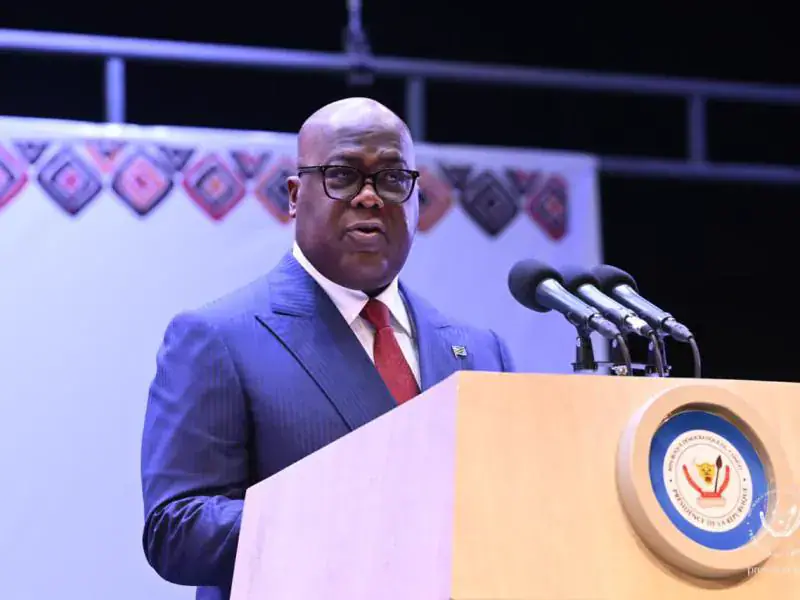
On October 30, 2026, Félix Tshisekedi, President of the Democratic Republic of the Congo, spoke to the Congolese diaspora in Moscow about the upcoming national dialogue. He emphasized that the process is moving forward, with the establishment of a committee to oversee the dialogue and the designation of its leaders imminent. The goal of the dialogue is to achieve peace, national cohesion, and the refoundation of the state. Tshisekedi's address was part of his participation in the Russia-Africa summit.
Tshisekedi reiterated his conditions for participation in the national dialogue, which include the denunciation of Rwandan aggression and the abandonment of any collaboration with Rwanda. He stressed that only those who have nothing to do with Rwanda will be able to participate in the dialogue as true Congolese citizens. The president's stance is clear: those who have worked with Rwanda must denounce their past actions and commit to working for the interests of the Congo.
The president explicitly stated that Congolese citizens who have collaborated with Rwanda, often referred to as "supplétifs du Rwanda," will not be allowed to participate in the dialogue. According to Tshisekedi, their participation would be aimed at defending Rwanda's interests rather than those of the Congo. He cited examples of such groups advocating for the recognition of Kinyarwanda as a national language and the sharing of Goma for joint management with Rwanda.
Tshisekedi also emphasized that the national dialogue is not about sharing responsibilities within institutions but rather about promoting justice and reconciliation. He believes that justice must play a crucial role in the reconciliation process to prevent further violence and ensure that those responsible for past atrocities are held accountable. The president's vision for reconciliation involves acknowledging past wrongdoings and taking concrete steps to prevent their repetition.
The national dialogue, officially launched in August 2026, aims to address the structural causes of instability in the Congo. The process is expected to last a maximum of three months, starting at the grassroots level and moving up to national institutions. However, the format of the dialogue has been met with disagreements within the political class, with some, like the opposition family of Joseph Kabila Kabange, contesting the modalities and seeking more guarantees for an inclusive and consensual process.
Tshisekedi's address to the Congolese diaspora in Moscow comes amid heightened tensions and ongoing hostilities between the Congolese government forces and the rebels of the AFC/M23, now known as FRN, who are supported by Rwanda. Diplomatic initiatives led by Washington and Doha have yet to yield significant results, despite several evaluation meetings. The situation on the ground remains volatile, with the conflict showing no signs of abating.
The Congolese government's efforts to initiate a national dialogue are seen as a crucial step towards achieving peace and stability. However, the process faces significant challenges, including the opposition's concerns about inclusivity and the participation of groups backed by Rwanda. As the situation continues to evolve, it remains to be seen whether the national dialogue will succeed in addressing the deep-seated issues driving the conflict in the Congo.
Key points
- The president of the Democratic Republic of the Congo, Félix Tshisekedi, has insisted that groups backed by Rwanda will not be allowed to participate in the national dialogue.
- The national dialogue aims to address the structural causes of instability in the Congo and promote justice and reconciliation.
- The process faces challenges, including opposition concerns about inclusivity and the participation of Rwandan-backed groups.