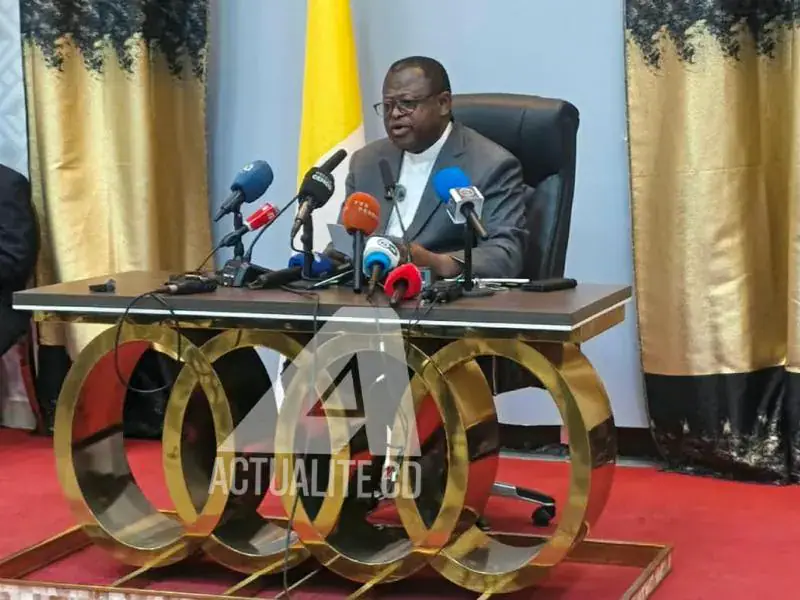
The Conférence épiscopale nationale du Congo (CENCO) has condemned recent incidents that disrupted the Catholic Church's activities in Kinshasa and Lubumbashi. On November 24, CENCO's secretary general, Monseigneur Donatien Nshole, addressed a press conference, calling on authorities to respect the Church's role and mission in society. He emphasized that considering the Church as a political enemy is misguided. The incidents involved the obstruction of the Journée diocésaine des jeunes at the Tata Raphaël stadium in Kinshasa and the repression of a peaceful Catholic march in Lubumbashi.
The CENCO has urged competent authorities to take necessary measures to guarantee the full exercise of rights and freedoms enshrined in the Constitution for all citizens, without discrimination. The Church's mission, CENCO stressed, is to promote the common good, peace, justice, and human dignity, while respecting the principle of state secularism. The recent incidents have revived tensions between the Catholic Church and the Félix Tshisekedi regime, which is accused of infringing on freedom of assembly, demonstration, and religion.
The incidents occurred in a context marked by security tensions related to Rwandan aggression and debates around a potential national dialogue and constitutional change. Clément MUAMBA reported on the CENCO's statement, highlighting the Church's willingness to contribute to the consolidation of the rule of law, finding durable solutions to the country's crises, and building genuine peace. The CENCO has reaffirmed its availability to work alongside all national stakeholders towards these goals.
The obstruction of the Tata Raphaël stadium event and the ban on the Catholic Church's march in Lubumbashi have sparked concerns about the government's attitude towards the Church. Mgr Fulgence Muteba, a prominent Church figure, has expressed concerns about the government's actions, stating that the situation may escalate. The CENCO's statement has also been supported by other stakeholders, including the Coordination des organisations chrétiennes pour la promotion de la démocratie et l'observation électorale (C64).
The C64 has denounced what it termed as an "authoritarian drift" by the regime, which it claims is extending repression to religious gatherings. The C64's statement echoed CENCO's concerns about the government's actions, emphasizing the importance of respecting the Church's role in promoting peace and stability. The incidents have sparked a national debate about the relationship between the state and the Church, with many stakeholders calling for greater respect for the Church's autonomy.
The tensions between the Church and the government have raised concerns about the potential impact on the country's stability. The Church has played a significant role in promoting peace and reconciliation in the Democratic Republic of Congo, and many stakeholders fear that the government's actions may undermine this effort. The CENCO's statement has been seen as a call to action for the government to respect the Church's role and mission.
The situation remains volatile, with many stakeholders watching closely to see how the government will respond to the CENCO's statement. The Church has reiterated its commitment to promoting peace and stability in the country, and many stakeholders are calling for greater dialogue between the government and the Church.
Key points
- The CENCO has condemned recent incidents involving the Catholic Church in Kinshasa and Lubumbashi.
- The incidents have revived tensions between the Catholic Church and the Félix Tshisekedi regime.
- The CENCO has reaffirmed its availability to work alongside all national stakeholders towards consolidating the rule of law and building genuine peace.