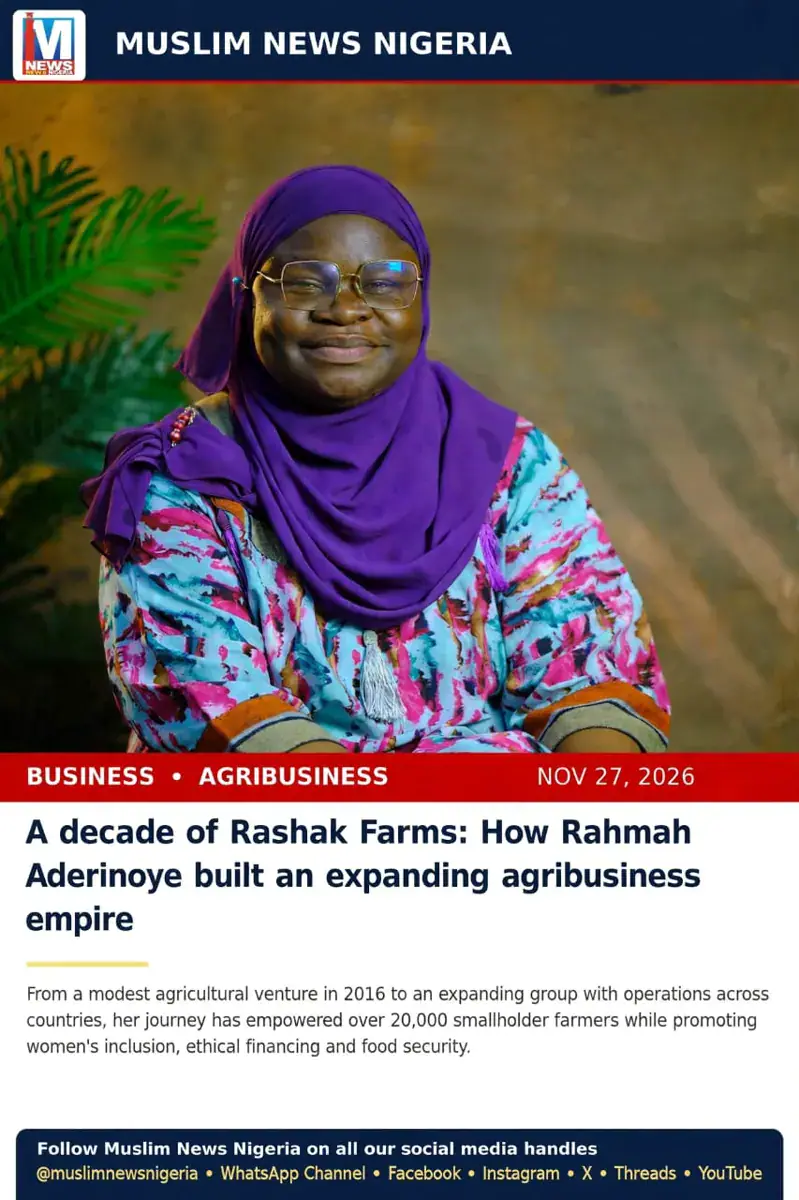
Rahmah Aderinoye founded Rashak Farms in 2016 with a vision to address poverty and hunger in Africa through agriculture. Ten years later, her enterprise has evolved into Rashak Group, an expanding agribusiness with operations across countries. The company has empowered over 20,000 smallholder farmers, promoting women's inclusion, ethical financing, and food security. Aderinoye's journey has not been without challenges, but her commitment to building a business that combines commercial ambition with Islamic principles has remained unwavering.
Aderinoye's decision to pursue agriculture was driven by her desire to make a meaningful contribution to society. She established Rashak Farms with a focus on supporting smallholder farmers through access to agricultural inputs, financing, training, and markets. The early years were particularly demanding, with distrust, theft, and financial losses threatening the survival of the young business. Despite these challenges, Aderinoye remained committed to her vision, and the support of loyal customers and people who believed in the company's vision helped it survive.
One of the most significant milestones in Aderinoye's ten-year journey is the transformation of Rashak Farms into Rashak Group. The enterprise now comprises four subsidiaries, employs more than 100 people, and has directly benefited over 20,000 smallholder farmers. Its agricultural interventions provide farmers with access to quality inputs, extension services, training, and reliable markets, helping them improve productivity and secure better returns from their harvests. Aderinoye said the farmers reached by the company remain her greatest source of pride.
Rashak's expansion interests now extend to Zambia, Singapore, Malaysia, and Qatar, marking an important stage in its ambition to become a significant player in Africa's agricultural value chain and international commodity trade. Aderinoye said the company intends to increase its reach from more than 20,000 farmers to 250,000 across Nigeria and other African countries over the next decade. The company's commitment to expanding economic opportunities for groups often excluded from mainstream agricultural programmes is reflected in its all-women wheat outgrower programme in Jigawa State.
Women, young people, and persons living with disabilities have remained central to Rashak's agricultural development model. Aderinoye believes these groups should be recognised as active economic participants rather than beneficiaries of charity. She noted that women constitute a significant proportion of the agricultural workforce in Sub-Saharan Africa but continue to face barriers to accessing land, finance, quality inputs, and markets. The company's interventions are designed to connect farmers to the resources and opportunities required to participate meaningfully in the agricultural economy.
Beyond its commercial achievements, Rashak's identity is strongly rooted in Islamic principles, particularly its commitment to interest-free financing and fair trade. Aderinoye explained that avoiding riba was a personal religious conviction rather than a business strategy. She recalled declining an offer of conventional bank financing during the company's early years because it involved interest. Rashak's zero-interest input financing allows farmers to access agricultural resources and repay through arrangements tied to their harvests.
Aderinoye's achievements have come against the backdrop of challenges associated with being a woman in an industry dominated by men. Her leadership has attracted support from partners of different religious backgrounds, demonstrating that Sharia-compliant business practices can operate successfully within a diverse commercial environment. As Rashak Group continues to expand, Aderinoye remains committed to her vision of empowering smallholder farmers and promoting sustainable agricultural practices.
Key points
- Rashak Group has empowered over 20,000 smallholder farmers across Nigeria and beyond.
- The company aims to increase its reach to 250,000 farmers across Nigeria and other African countries over the next decade.
- Rashak's business model is rooted in Islamic principles, including interest-free financing and fair trade.
Reporting sources
- A decade of Rashak Farms: How Rahmah Aderinoye built an expanding agribusiness empire · Muslim News Nigeria