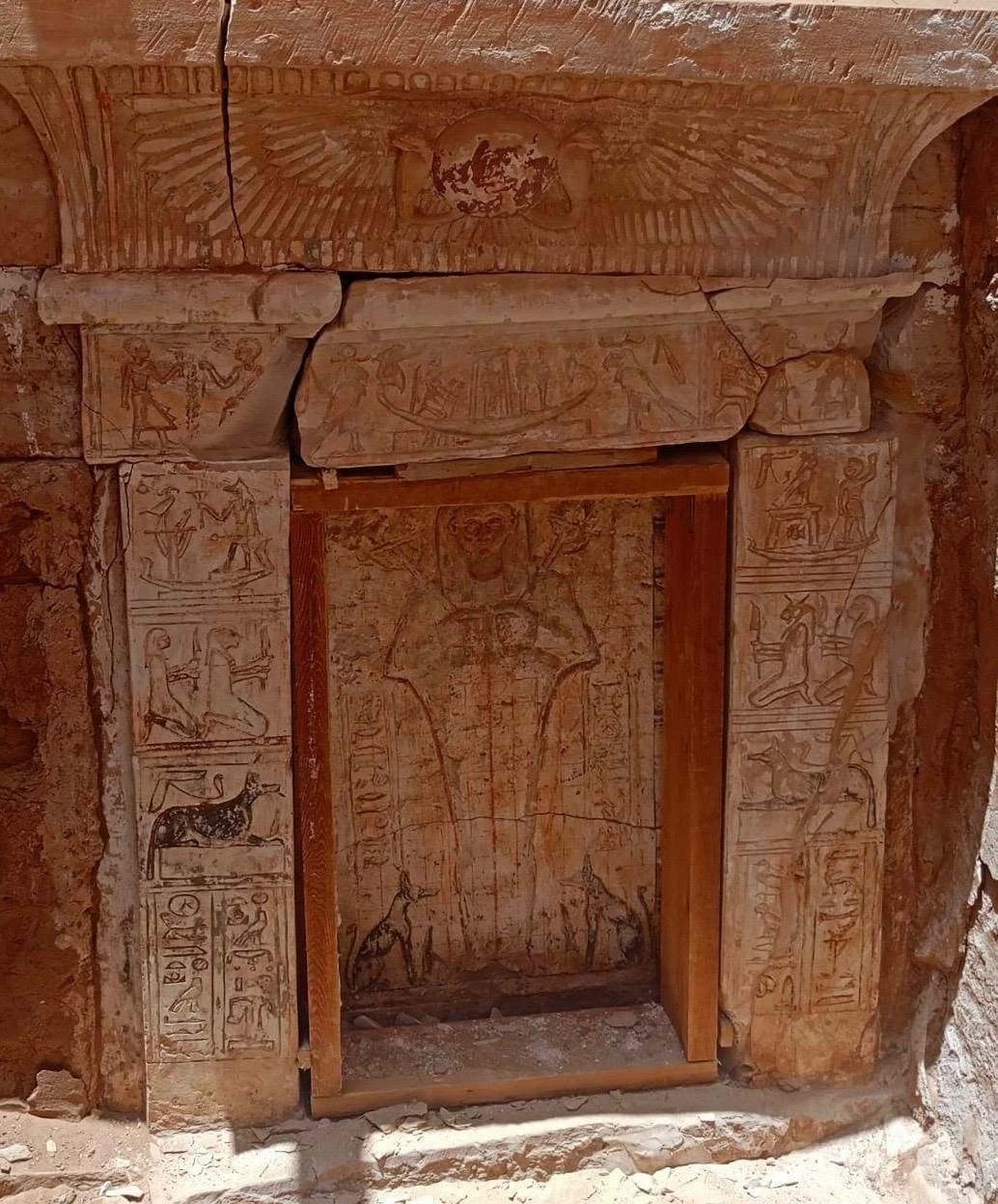
A recent archaeological discovery in Egypt's New Valley has unveiled a pyramid tomb and a Greek epitaph, shedding light on the region's rich history during the Roman era. The Egyptian archaeological mission, affiliated with the Supreme Council of Antiquities, made the find in the area of Bir al-Shagala, located in the Dakhla Oasis. The tomb, constructed from mudbrick, dates back to the Roman era and was built for a man and his wife.
The tomb features a unique architectural design that combines elements of ancient Egyptian and Greek-Roman styles. The entrance, made of sandstone, is adorned with hieroglyphics and leads to a subterranean chamber with a vaulted ceiling. The tomb's design is significant, as it reflects the cultural exchange and influences of the time. The Supreme Council of Antiquities announced the discovery, highlighting the importance of the find.
The archaeological team discovered a stone slab with a Greek epitaph, which is a rare find in the region. The epitaph, dated to the 3rd or 4th century AD, is a poem of 19 lines, dedicated to a man named Pesixtis, who may have been a judge. The inscription provides valuable insights into the literary and cultural life of the oasis during the Roman era.
The tomb also yielded other significant artifacts, including a stone offering table, a sandstone purification basin, and several ceramic vessels. A bronze coin bearing the image of Roman Emperor Constantine was also found. These discoveries suggest that the tomb may have been reused in a later period.
The Bir al-Shagala area is a significant archaeological site, representing one of the necropolises of the ancient city of Mothis, which was the capital of the Dakhla Oasis during the Ptolemaic and Roman periods. Excavations began in the area in 2002, and several tombs have been uncovered, showcasing a mix of Egyptian, Greek, and Roman architectural styles.
The tombs discovered in the area demonstrate a unique blend of cultural influences, reflecting the complex history of the region. Some of the tombs feature an upper level with a funerary shrine, topped with a pyramidal structure, indicating that the necropolis may have been reserved for the burial of high-ranking individuals.
The discovery of the pyramid tomb and Greek epitaph provides a fascinating glimpse into the lives of the people who lived in the Dakhla Oasis during the Roman era. The find is a significant addition to Egypt's rich cultural heritage, offering insights into the region's history, literature, and culture.
Key points
- The discovery includes a rare pyramid tomb and a Greek epitaph, dated to the Roman era.
- The tomb features a unique blend of Egyptian and Greek-Roman architectural styles.
- The find provides valuable insights into the cultural and literary life of the Dakhla Oasis during the Roman era.