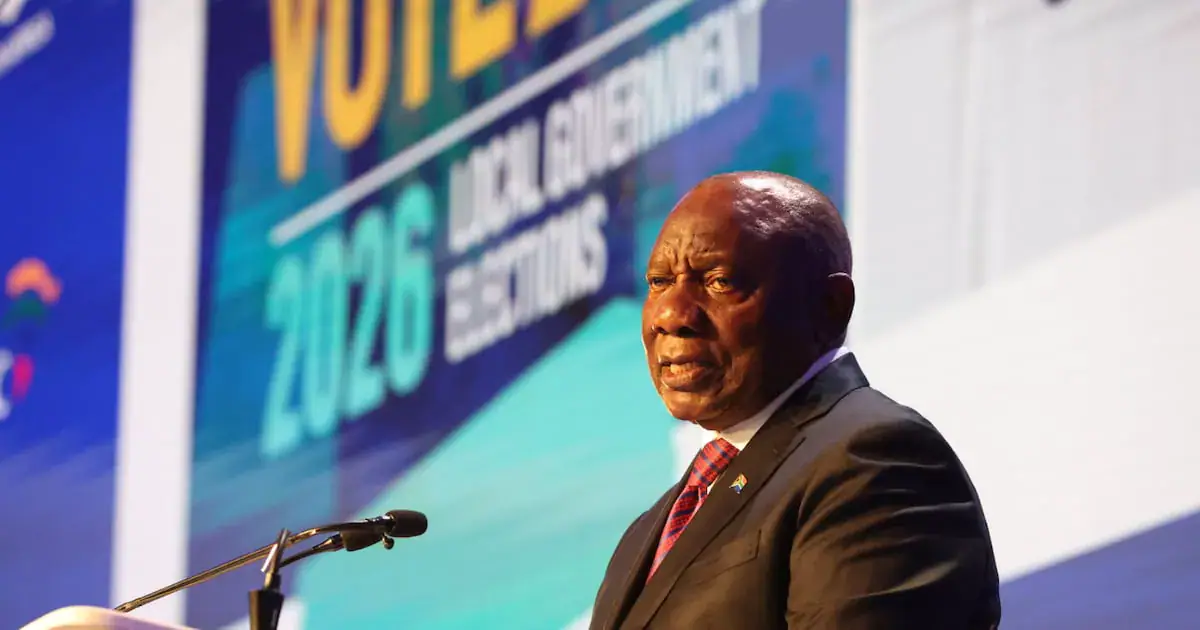
South African President and ANC leader Cyril Ramaphosa is set to face a significant test of unity within his party as it navigates coalition talks following the local government elections. The ANC's national executive committee will meet to discuss the party's governance strategy, with divisions emerging over proposed coalitions with other parties, including ActionSA, the EFF, and MK Party. These coalitions have sparked debate over the party's long-term survival and concerns about corruption and poor governance.
According to sources within the ANC, President Ramaphosa directed the party's national working committee to avoid coalitions with the DA, instead favouring pacts with other parties. This decision has been met with resistance from some members, who argue that coalitions with parties like ActionSA and MK would be detrimental to the ANC's future. The party's Gauteng structures, for example, are sharply divided over a proposed coalition with ActionSA in Johannesburg, which would include the EFF and MK.
Critics of the proposed coalitions argue that they would undermine the ANC's reform agenda and increase corruption risks. In Tshwane, an ANC insider described a coalition with ActionSA as the "death" of the party, citing the significant loss of support to ActionSA in the 2026 local government elections. ActionSA took the lead in 191 voting districts that the ANC had won in 2021, flipping major ANC strongholds across Tshwane townships.
The ANC's KwaZulu-Natal structures have denied deep divisions over a possible tie-up with MK, but former provincial secretary Bheki Mtolo has cautioned against framing pacts with MK and EFF as "black party unity". This approach, he argues, betrays the ANC's non-racial principles and empowers rivals seeking to erode its voter base. Prominent ANC elders, including Snuki Zikalala and Mavuso Msimang, have also expressed concerns about legitimizing MK through a coalition.
Gauteng premier Panyaza Lesufi, who has long opposed a tie-up with the DA, is supported by the ANC Youth League and regional Gauteng metro leaders. They argue that partnering with the DA damaged the ANC's working-class support and advocate for a "progressive" bloc within the party to retain executive influence. In Johannesburg, a multiparty alliance has been proposed, including ActionSA, MKP, EFF, and other parties.
The private sector has also weighed in on the coalition talks, with Business Unity South Africa, Business Leadership South Africa, and Business for South Africa warning that the stalemate is a "national economic emergency". DA leader Geordin Hill-Lewis has released a "stability framework" proposal, which suggests that the ANC would lead 93 councils, the DA 24, and the IFP 20. Hill-Lewis argues that this proposal would strengthen the government of national unity and offer a chance for nationwide progress.
As the ANC's national executive committee prepares to make its decision, President Ramaphosa faces a critical test of unity within his party. The outcome of the coalition talks will have significant implications for the ANC's future and the country's governance landscape. With various factions within the party holding different views, Ramaphosa will need to navigate these complex dynamics to find a solution that balances the ANC's interests with the needs of its constituents.
Key points
- ANC president Cyril Ramaphosa faces divisions within his party over proposed coalitions with other parties, including ActionSA, EFF, and MK Party.
- Critics argue that coalitions with these parties would undermine the ANC's reform agenda and increase corruption risks.
- The private sector has warned that the stalemate in coalition talks is a "national economic emergency".
Reporting sources
- # 1 Ramaphosa faces tough ANC unity test in coalition talks · The Sunday Times