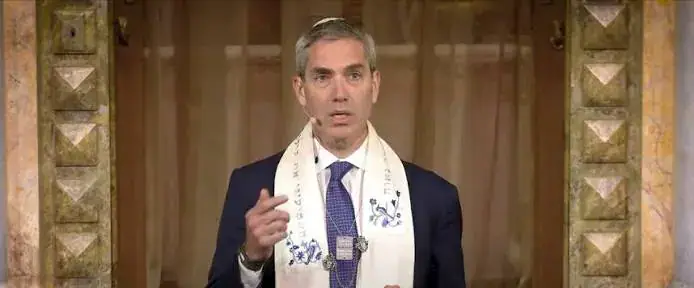
Rabbi Elliot Cosgrove, spiritual leader of New York City's Park Avenue Synagogue, has emerged as a moral voice in the prophetic tradition, particularly in the context of the recent Israeli elections. With the passing of Elie Wiesel and Rabbi Lord Jonathan Sacks, Cosgrove has taken on a crucial role in addressing complex issues facing the Jewish community and the State of Israel. His recent sermon highlighted the importance of 19 Knesset seats held by The Joint List and Ra'am, a political alliance of Arab-majority Israeli parties.
Cosgrove's sermon emphasized that the significance of these parliamentary seats lies in the hundreds of thousands of non-Jewish Israeli citizens who have become a major force in Israel's political reality. Ra'am head Mansour Abbas stated, "We are here and we're not on the sidelines," as the results were coming in. Cosgrove has consistently shown courage in addressing divisive issues, and his words and teachings reach far beyond his congregation through live-streamed sermons and articles.
As a staunch Zionist, Cosgrove has not hesitated to criticize Israeli government policies that diverge from the values and principles that brought the modern Jewish State into being. He was a principal speaker at a demonstration outside the United Nations on September 22, 2023, protesting against Netanyahu's proposed scuttling of Israel's independent judiciary. Cosgrove declared, "We are here because of our commitment to an Israel based on freedom, justice, and peace as envisioned by the prophets of Israel."
Cosgrove noted that the major Jewish-led opposition parties have rejected the possibility of being in coalition with Arab parties, despite the fact that Israel's Arab citizens have voted in extraordinary numbers, sending 19 representatives to the Knesset. This paradox of Israeli democracy raises questions about the role of Arab parties in the country's politics. Cosgrove asked, "Can the Jewish family find room in its household for those who do not share its Jewish identity? Can we secure our own destiny while acknowledging the presence of another?"
The current political deadlock in Israel may require the opposition to consider coalition possibilities with Arab parties. However, some opposition leaders, such as Avigdor Liberman, refuse to sit in a coalition with either Netanyahu or any Arab party. The maths appears to be that without Liberman's seven seats, the opposition to Netanyahu cannot command a majority in the Knesset. This raises questions about the potential for a minority government backed by Arab parties from the outside.
Writing in the Los Angeles Jewish Journal, Thane Rosenbaum asked if Israel can afford to have a Muslim politician who is agnostic about terror serve in the Cabinet and attend security briefings. However, this question ignores the corollary: can Israel afford to have fascist Itamar Ben-Gvir, who encourages settler violence against Palestinian civilians, serve in the Cabinet and attend security briefings? Cosgrove correctly points out that a coalition including Arab representatives would not settle the Palestinian question or erase inequality but would reflect Israel's democratic promise.
Cosgrove's sentiments echo those of Prime Minister Yitzhak Rabin, who stated in a television interview before his assassination, "The question, 'do you have a Jewish majority?' is one of the questions that is most outrageous to me because in my eyes, Judaism and racism contradict each other at their core." Cosgrove emphasized that it is not his place to advocate for a particular coalition arrangement, but he believes that different scenarios, including a coalition with Arab parties, hold possibilities for breaking the deadlock and opening new horizons for Israel's future.
Key points
- Rabbi Elliot Cosgrove emphasizes the significance of Arab parties in Israeli politics and the potential for a coalition including Arab representatives to reflect Israel's democratic promise.
Reporting sources
- A flickering light in an ever-darkening darkness · Jewish Report