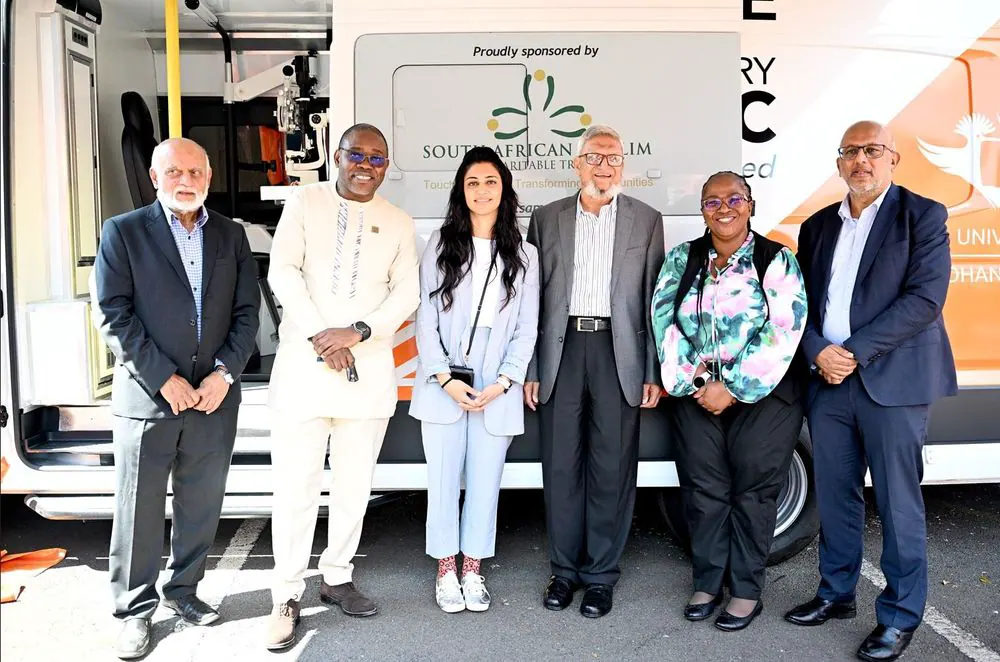
The University of Johannesburg (UJ) and the South African Muslim Charitable Trust (SAMCT) have launched a R2.5 million Mobile Optometry Clinic to provide comprehensive eye care to communities. The clinic is designed to deliver eye care directly to communities, particularly those who have limited access to such services. The vehicle is equipped with a fully fitted optometry diagnostics platform and facilities to make prescribed lenses.
According to Professor Nabeela Hasrod Gany, Head of the UJ Department of Optometry, the philosophy behind the project is to close the loop between diagnosis and immediate treatment. The clinic will bring clinicians, equipment, and a spectacle lab to communities, allowing patients to receive spectacles on the same day. This initiative responds to a global challenge of access to eye care, with at least 2.2 billion people worldwide living with near or distance vision impairment.
The World Health Organisation (WHO) estimates that at least 1 billion cases of vision impairment could have been prevented or remain unaddressed. Uncorrected refractive error remains a leading cause of vision impairment in both children and adults. In South Africa, the UJ Department of Optometry has established a community outreach programme, conducting 53 outreach initiatives in 2025, examining approximately 5,520 patients, and providing 1,038 pairs of spectacles free of charge.
However, traditional outreach presents a challenge, as patients often have to return to collect spectacles, which can be a barrier for those living far from established eye-care services. The new Mobile Optometry Clinic changes this by bringing eye care to the patient. UJ Vice-Chancellor and Principal, Professor Letlhokwa Mpedi, said that access to healthcare shouldn’t be determined by where a person lives or the resources available to them.
The Mobile Optometry Clinic has been designed to provide comprehensive eye examinations and ocular health assessments. It incorporates a fully integrated spectacle-cutting laboratory, allowing lenses to be edged and glazed on-site. This creates the potential for a patient to move from eye examination to prescription, to spectacle manufacture and dispensing within the same community outreach visit.
The model is particularly significant, as uncorrected refractive error can affect education, employment, independence, and quality of life. Globally, vision impairment is associated with an estimated $411 billion in annual productivity losses. Shabir Chohan, one of the SAMCT Trustees, proposed replicating this model nationally and expanding it into integrated community development.
The Mobile Optometry Clinic will undertake its first community deployment in Cosmo City on World Sight Day in October 2026. The clinic will also serve as a mobile teaching platform for UJ Optometry students, exposing future practitioners to the realities of healthcare access while developing clinical competence, adaptability, and socially responsive practice.
Key points
- The University of Johannesburg and South African Muslim Charitable Trust have launched a R2.5 million Mobile Optometry Clinic to provide comprehensive eye care to communities.
- The clinic will bring clinicians, equipment, and a spectacle lab to communities, allowing patients to receive spectacles on the same day.
- The initiative aims to close the gap in access to eye care, particularly for underserved communities.