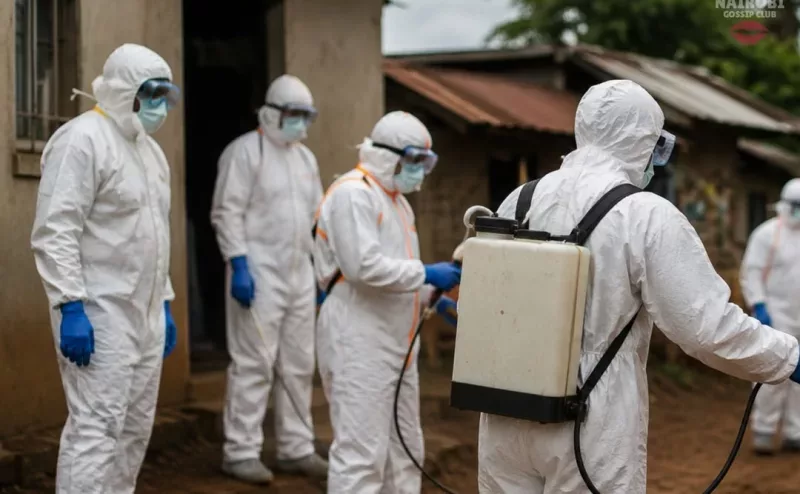
A 40-year-old Kenyan businessman, who had lived in the Democratic Republic of Congo for seven years, travelled extensively across the region while infected with Ebola, without being detected. He eventually died in a Nairobi hospital on 5 October, after being diagnosed with the disease. The man's movements, which spanned nearly six weeks and multiple countries, have raised concerns about the effectiveness of health screenings and biosecurity measures in the region. His case has highlighted the challenges of containing the spread of Ebola in a region with porous borders and limited resources.
According to Africa CDC, the man's symptoms first emerged around 15 September, but he was not diagnosed with Ebola until he arrived at a Nairobi hospital. During his travels, he visited several towns in DR Congo, including Buta, Aketi, and Likati, where Ebola cases had been reported. He also spent time in Kisangani, a city with a population of about 1.5 million people, and crossed into Uganda, where he travelled to the capital, Kampala, and then Entebbe International Airport, from where he flew to Nairobi. The man's itinerary has been reconstructed by Africa CDC, which is leading efforts to track down people who may have come into contact with him.
The man's case has highlighted the limitations of relying on temperature checks and self-declarations to detect Ebola cases. Health experts say that his medication may have suppressed his temperature, or that he may not have had a fever when he passed through airport screenings. The incident has raised questions about the effectiveness of health screenings at airports and border crossings, and the need for more robust measures to detect and prevent the spread of Ebola. The WHO has warned that stigma surrounding Ebola could discourage people from reporting symptoms or seeking medical care.
The Kenyan government has identified 66 people who may have been in contact with the man after he arrived in Nairobi, but the number is likely to rise as contact-tracing in Uganda and DR Congo continues. The government has also taken steps to enhance its response to the outbreak, including screening over 652,000 travellers and training nearly 5,000 healthcare workers to deal with Ebola. Five facilities have been designated to handle Ebola cases, and the government has urged people to report any symptoms of the disease.
The WHO has warned that the outbreak in DR Congo, which has killed over 4,000 people this year, is a significant public health risk, and that the virus could spread to other countries if not contained. The agency has stepped up efforts to encourage people to report symptoms and seek medical care, and to reduce fear and misinformation about the disease. The incident has also highlighted the need for improved coordination and cooperation between countries in the region to prevent the spread of Ebola.
Dr Wessam Mankoula, emergency director at Africa CDC, has urged travellers experiencing symptoms of Ebola to report them, saying early medical attention could improve their chances of survival. Mankoula also emphasized the importance of cooperation and coordination between countries in the region to prevent the spread of the disease. The incident has highlighted the need for continued vigilance and cooperation to prevent the spread of Ebola in the region.
The Kenyan patient's case has been closed, with 66 people identified as having been in contact with him after arrival in Nairobi. The incident serves as a reminder of the need for continued vigilance and cooperation between countries to prevent the spread of Ebola and other infectious diseases. Key efforts are underway to enhance screening, contact tracing, and infection control measures in the region.
Key points
- A Kenyan businessman travelled across three nations undetected while seriously ill with Ebola.
- The incident has raised questions about the effectiveness of health screenings and biosecurity measures in the region.
- The WHO has warned that stigma surrounding Ebola could discourage people from reporting symptoms or seeking medical care.