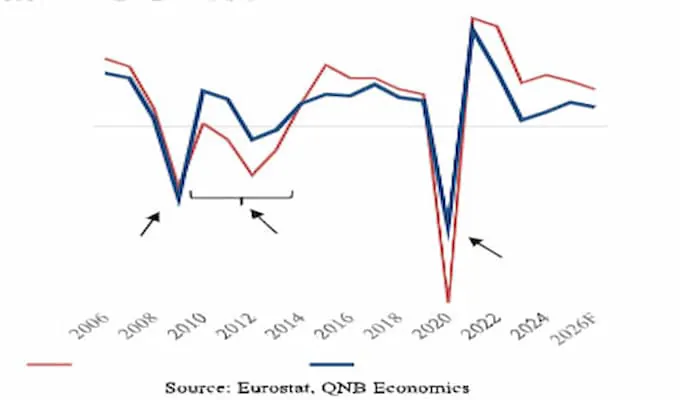
In the years following the global financial crisis, Spain embodied Europe's economic woes. The country was among the vulnerable peripheral economies, with doubts about its solvency. However, today, Spain has become one of the most performing advanced economies. According to QNB Economics, Spain's growth rate is expected to be the highest in the eurozone in 2026. This transformation is attributed to structural adjustments and favorable factors that have reshaped the Spanish growth model.
The Spanish economy was severely hit by the crisis, with unemployment peaking at over 26% in 2013 and a banking system requiring a €100 billion bailout. The public deficit had also reached a two-digit level. However, the situation has changed radically. The country's growth rate has been superior to that of the eurozone, which has barely grown by over 1%. This transformation is attributed to three factors: a more competitive and diversified export base, a demographic and labor market renewal, and a favorable investment and energy dynamic.
The adjustment made after the crisis allowed Spain to restore its competitiveness and broaden its export base. Reforms implemented after 2010 aimed to promote stable and permanent employment. Wage moderation also contributed to reducing labor unit costs, strengthening the international competitiveness of Spanish companies and fueling export recovery. The government also restructured and merged fragile regional savings banks, contributing to the stability of the financial sector.
Spain has become an important hub for new foreign investment projects and technological talent, particularly thanks to devices for digital nomads. These improvements have enabled the Spanish economy to develop its services exports with higher added value, particularly in finance, information technology, and professional services. As a result, the economy has become more diversified and better protected against shocks. The country has also moved from historically chronic trade deficits to record current account surpluses.
Demographic and labor market renewal has become a powerful growth driver. Although the global financial crisis destroyed over three million jobs, employment has since rebounded to record levels. Unemployment, although still one of the highest in the eurozone, has fallen to around 10%, less than half its 2013 peak. Immigration of highly qualified workers, mainly from Latin America, has played an important role in this development.
The dynamics of investment and energy have consolidated the recovery. Spain is among the main beneficiaries of the European Union's post-pandemic recovery program, which mobilizes significant financing for investment and modernization. The country's massive investments in renewable energy and limited dependence on imported gas have allowed it to mitigate the effects of recent energy price shocks. These factors have supported robust domestic demand, while public finances are on a gradual improvement trajectory.
Overall, Spain's transformation from crisis victim to growth leader shows how structural reforms, diversification, and favorable conjunctural factors can together transform an economy's prospects. Challenges remain, however. Unemployment remains high compared to European standards, public debt is around 100% of GDP, and maintaining strong long-term productivity growth remains difficult.
Key points
- Spain's economy has transformed from a crisis-hit victim to a growth leader, with a growth rate expected to be the highest in the eurozone in 2026.
- The transformation is attributed to structural adjustments and favorable factors that have reshaped the Spanish growth model.
- Challenges remain, including high unemployment and public debt.