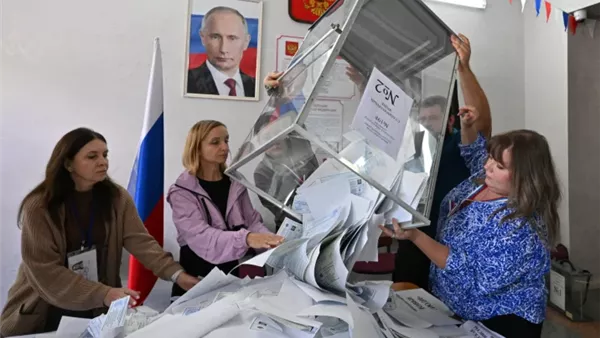
Russian President Vladimir Putin's party, United Russia, has secured a significant victory in the Duma elections, winning 57.86% of the vote. According to the Russian news agency Tass, the party won the most seats after tallying 90.43% of the ballots. This win cements Putin's control over the Russian political landscape. United Russia's victory ensures that Putin will have the necessary support to pass legislation and make key decisions without facing significant opposition.
The Communist Party of the Russian Federation came in second with 13.84% of the vote, followed by the Liberal Democratic Party with 8.9%, and the New People party with 7.94%. The remaining parties, including the Just Russia party, received less than 5% of the vote. The elections saw a significant turnout, with voters from the newly annexed regions of Donetsk, Luhansk, Kherson, and Zaporizhzhia participating in the voting process. These regions were annexed by Russia in September 2022, although the move has not been recognized by the international community.
The outcome of the elections has significant implications for Putin's rule and the Russian political landscape. The results provide Putin with the necessary legitimacy to make key decisions, including potential constitutional changes and decisions related to the ongoing conflict in Ukraine. The elections have also seen the entry of dozens of veterans who fought in the war against Ukraine into the Duma. This could make any potential return to a more peaceful political process in the post-Putin era more challenging.
Putin's opponents have criticized the election results, stating that the continued dominance of United Russia will lead to an expansion of political repression and corruption. They also argue that the party's victory will result in reduced budgets for education, healthcare, and housing in favor of increased military and security spending. The Russian judiciary has also taken steps to limit opposition, including the exclusion of the Yabloko party from the electoral process.
The international community has also weighed in on the election results. The European Union has criticized the electoral process, citing a lack of genuine competition and allegations of vote rigging. The EU has also expressed concerns about the restrictive environment in which the elections were held. In response, Russian Foreign Ministry spokesperson Maria Zakharova accused the West of attempting to disrupt the voting process.
Putin's current presidential term runs until 2030, and he does not currently need to make constitutional changes to remain in power. However, the elections have provided him with a significant mandate to pursue his agenda. The outcome has also demonstrated that Putin remains popular among Russian voters, with his party securing a significant majority in the Duma.
The election results have significant implications for the future of Russian politics and Putin's rule. The outcome ensures that Putin will continue to have a significant degree of control over the Russian political landscape. The entry of veterans into the Duma could also have significant implications for the future of Russian politics, potentially making it more challenging to transition to a more peaceful and democratic political process in the future.
Key points
- United Russia's victory in the Duma elections cements Putin's grip on Russian politics.
- The elections have significant implications for Putin's rule and the Russian political landscape.
- The international community has criticized the electoral process, citing a lack of genuine competition and allegations of vote rigging.