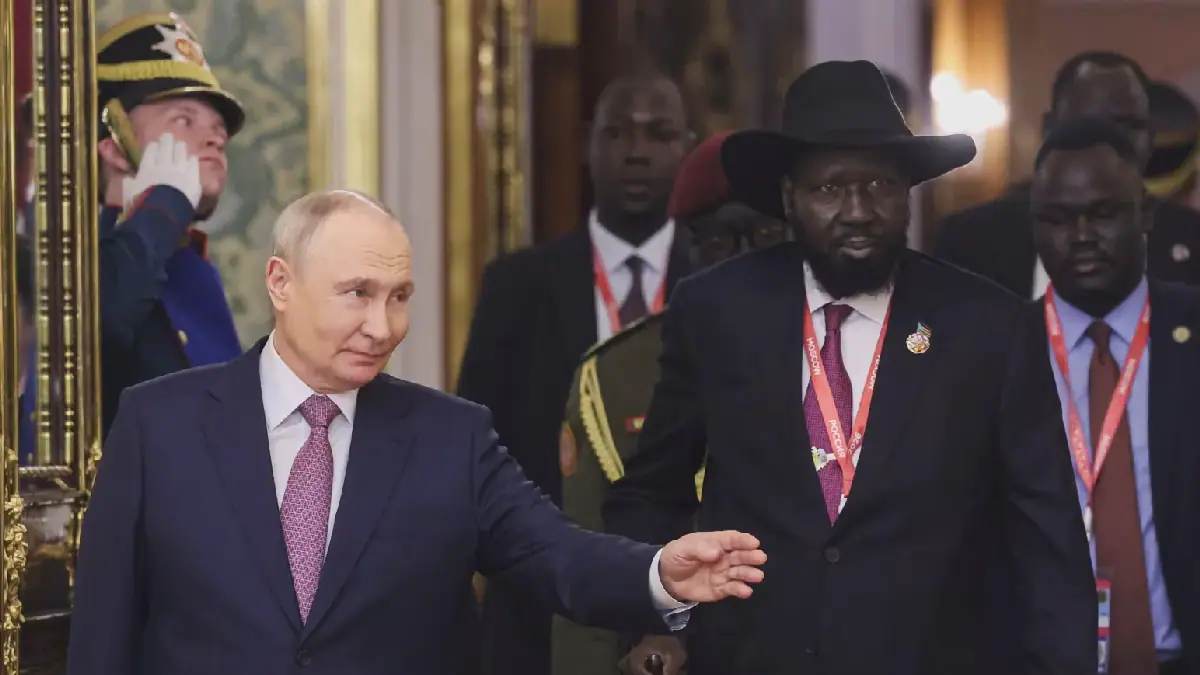
Russian President Vladimir Putin welcomed delegations from 48 African countries to the third Russia-Africa Summit in Moscow, aiming to strengthen ties and counter growing international isolation due to the Ukraine war. Putin portrayed Russia as a better partner for Africa than the West, accusing Western nations of exploiting Africa's resources and using debt to hinder development. He emphasized Russia's model of cooperation, allowing both parties to prosper through trade and technology ties. Putin also highlighted Russian companies' support for local job creation and tax revenues.
African governments are adopting a strategy of "diversified non-alignment," maintaining ties with multiple partners rather than committing to one camp. According to Tighisti Amare, director of the Africa Program at Chatham House, their reasons vary, including seeking security support, agricultural supplies, energy investment, or diplomatic backing. Will Brown, an Africa policy specialist, notes that images of Putin alongside African leaders can shape perceptions across Africa and the Global South. The summit's visibility helps Moscow counter its growing international isolation due to punitive Western sanctions.
Russia has gained ground in Mali, Burkina Faso, and Niger, where military-led governments turned to Moscow for military support after breaking with Western partners. The Africa Corps, a paramilitary organization, has assumed much of Wagner's work after the mercenary group's 2023 mutiny against the Kremlin. Anna Ida Rock, a researcher at the Swedish Defense Research Agency, reports Africa Corps has a presence in several countries, including Burkina Faso, the Central African Republic, and Mali. Russian military instructors have also been reported in other African nations.
The shift from Wagner to Africa Corps was more than a name change, with the new force operating openly under Russia's Defense Ministry and military intelligence. Many personnel are former Wagner fighters, but Africa Corps focuses on training, advising, and protecting strategic sites. Results vary, with Russian forces helping the Malian government retake a city, but insecurity worsening and Africa Corps suffering significant losses. In Burkina Faso, Russian personnel have focused on protecting the government during political instability.
Despite its growing political and security presence, Russia's trade with Africa remains limited, estimated at $27 billion in 2025, below the $40 billion target set in 2019. Putin has set a new goal of over $50 billion. China and the European Union are far larger trading partners for Africa, with China-Africa trade reaching $348 billion and EU-Africa trade standing at $395 billion in 2025. Agriculture is one area where Russia has established stronger commercial ties, with Putin announcing 13 million metric tons of agricultural products exported to Africa in the first nine months of 2026.
Energy cooperation is another area of focus, with Russia's state nuclear company, Rosatom, building Egypt's El Dabaa nuclear power plant. Talks about floating nuclear plants elsewhere have not reached construction. Putin also promoted digital cooperation and local production of medicines and vaccines at the summit. However, Amare notes that turning these proposals into tangible results will require investment, production facilities, and skills.
The summit also saw Ethiopia's Prime Minister Abiy Ahmed announce that his country had received Russian Su-35 fighter jets and would acquire four S-400 long-range air-defense systems. The deal's value and delivery schedule have not been disclosed. Russia's arms exports overall continue to decline, with the Stockholm International Peace Research Institute reporting a 64 percent drop between 2016-2020 and 2021-2025.
Key points
- Russia is seeking to expand its influence in Africa through the Russia-Africa Summit.
- African governments are adopting a strategy of "diversified non-alignment," maintaining ties with multiple partners.
- Russia's trade with Africa remains limited, despite growing political and security ties.