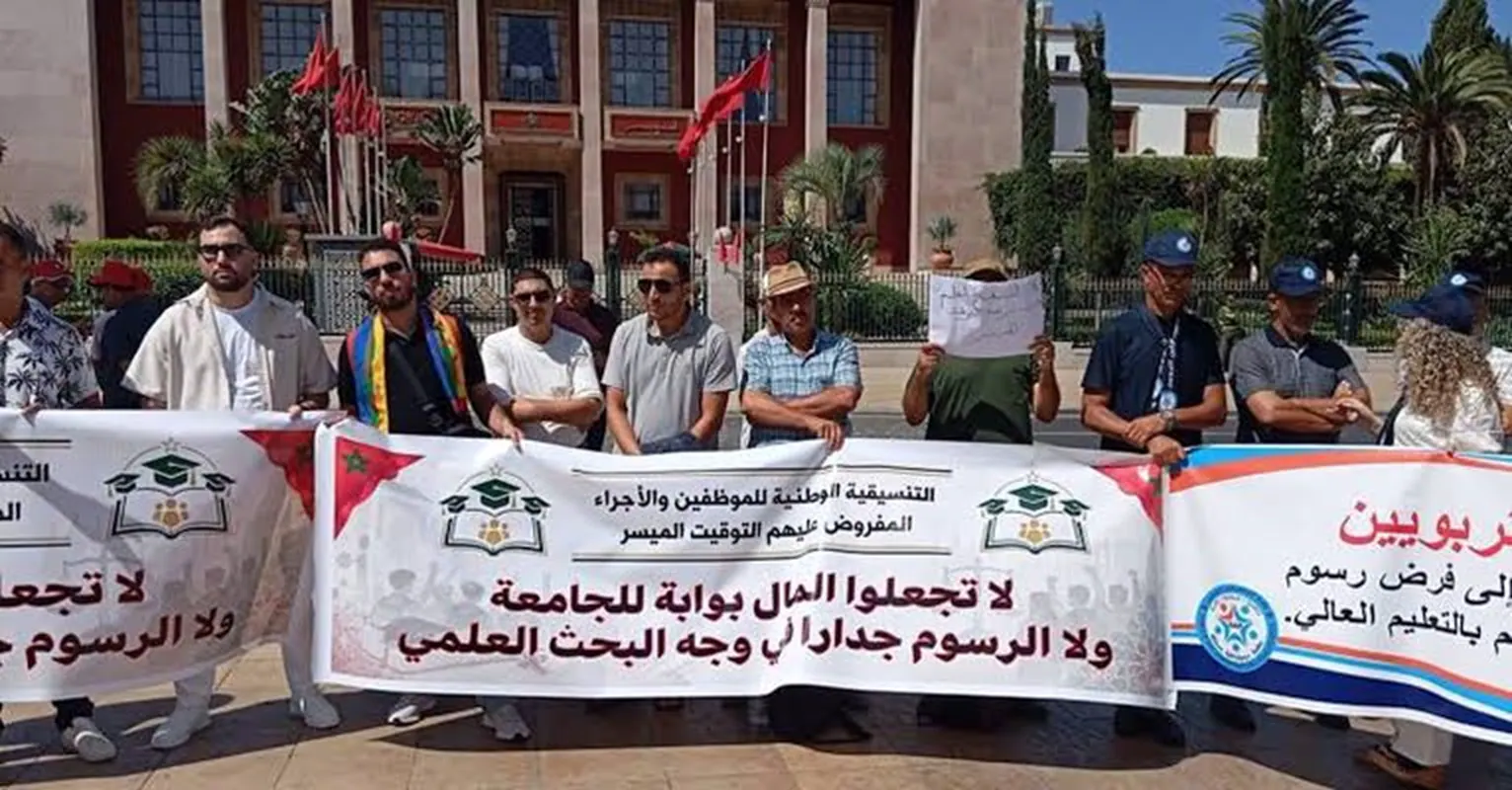
A national coordination committee of employees and workers in Morocco has announced a nationwide protest on Sunday, October 4, 2026, in front of the parliament building in Rabat. The protest is against the imposition of fees for higher education. The committee had previously sent letters to several institutions, including the mediator of the Kingdom, the head of government, and the Ministry of Higher Education, Scientific Research, and Innovation, requesting intervention to halt what they consider an infringement on the principle of free higher education.
The coordination committee expressed its rejection of imposing fees on student employees, warning that it threatens the principle of free higher education and cautioning against attempts to introduce a payment logic and privatization into the public university. Meanwhile, the office of dental students in Casablanca announced on September 26, 2026, that they would stage a protest on Tuesday. The students criticized the increase in the number of seats without corresponding expansion of training spaces or provision of medical equipment and supplies.
The dental students' office reported that their open-ended strike, which began on September 8, has entered its fourth week with full participation. They decided to hold a massive protest in the courtyard of the central dental examination and treatment center in Casablanca. The protests come as Morocco is yet to appoint a new head of government. The situation reflects growing discontent among various groups over recent reforms and policies.
The protests in Morocco are not limited to education but also encompass healthcare reforms. Various groups have been expressing dissatisfaction with recent changes, citing concerns over accessibility and quality of services. The government's response to these concerns will be crucial in determining the trajectory of these protests and their impact on the country's social and political landscape.
The announcement of the protests and the participation of various groups, including students and employees, indicate a broader discontent with the current state of affairs in Morocco. The government's policies and reforms have sparked widespread debate, with many questioning their impact on the country's social services and economic development.
The situation in Morocco is being closely watched by various stakeholders, including human rights groups and international organizations. The country's commitment to social and economic development, as well as its human rights record, has been a subject of interest and scrutiny. The protests and the government's response will likely have implications for Morocco's relations with the international community.
As the protests continue and the situation unfolds, it remains to be seen how the Moroccan government will address the concerns of various groups and navigate the complex landscape of social and economic reforms. The appointment of a new head of government and the implementation of policies will be critical in determining the country's future trajectory.
Key points
- The protests in Morocco reflect growing discontent among various groups over recent reforms and policies in education and healthcare.
- The government's response to these concerns will be crucial in determining the trajectory of these protests and their impact on the country's social and political landscape.
- The situation in Morocco has implications for the country's social and economic development, as well as its human rights record.