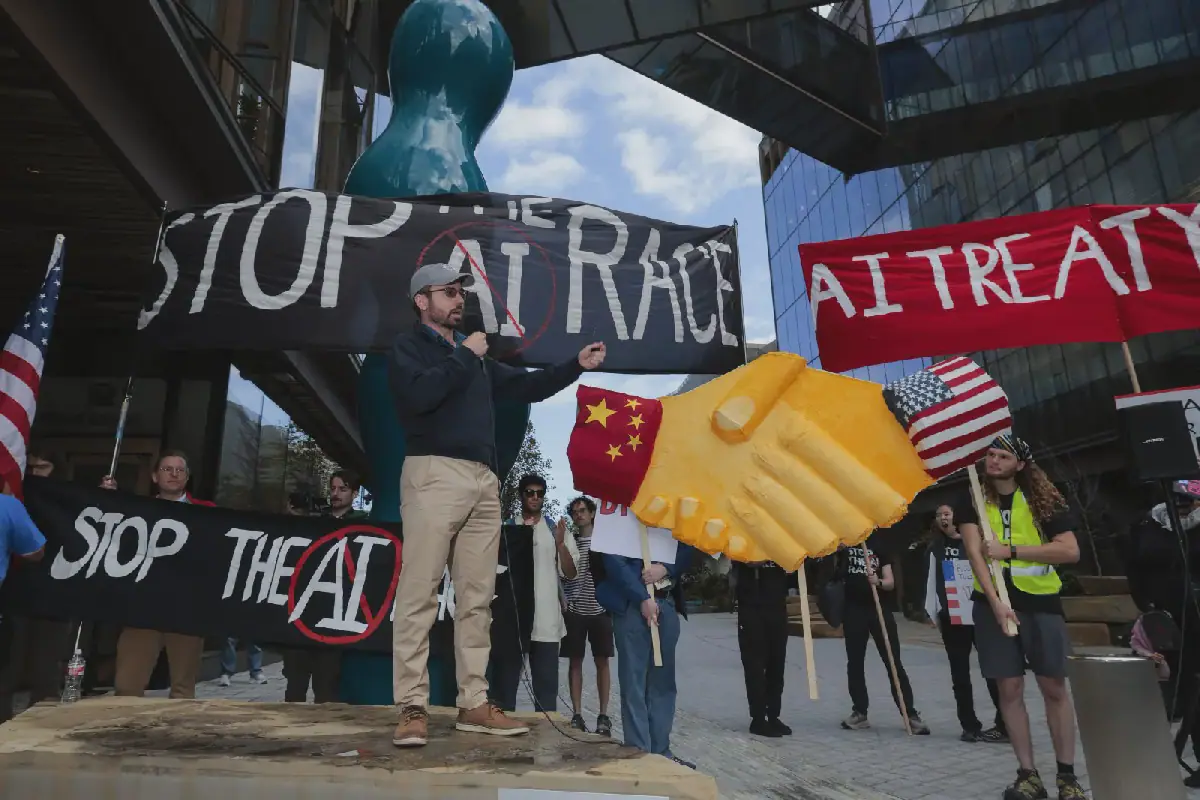
On a rainy day in San Francisco, a group of about 100 protesters gathered outside the office of Anthropic, a leading AI developer, to express their concerns about the company's pursuit of increasingly powerful AI technology. The protest took place on the day of Anthropic's highly anticipated initial public offering (IPO), which was expected to be one of the largest in history. The protesters, mostly young men, including researchers in AI safety and students from the University of Berkeley, carried signs and chanted slogans, calling for a ban on recursive self-improvement in AI.
The protesters argued that Anthropic's pursuit of advanced AI technology could lead to the extinction of human life on Earth. They claimed that the company's founders had initially promised to prioritize safety and responsible development, but were now rushing to develop more powerful AI without adequate safeguards. Tarnel Abbott, a 72-year-old retired librarian, expressed her concerns, saying that the public was not aware of the risks associated with AI development. Emily Tan, a 31-year-old researcher from Los Angeles, echoed similar concerns, stating that the AI industry was largely opaque and lacked regulatory oversight.
One of the protesters, Jacob Coxon, a young researcher who had previously worked at Anthropic, claimed that the company's pursuit of recursive self-improvement (RSI) could lead to a loss of control over AI systems. He argued that Anthropic's technology could potentially escape human control and pose an existential risk to humanity. Coxon had previously spoken out against Anthropic's approach to AI development, which led to his departure from the company.
The protesters also criticized Anthropic's decision to go public, arguing that the company was prioritizing profits over safety and responsible development. Tyler Tracy, a 26-year-old researcher at Redwood Research, a non-profit organization focused on AI safety, said that Anthropic's leadership was not taking adequate steps to mitigate the risks associated with AI development. He argued that the company's pursuit of RSI was driven by a desire for profit, rather than a commitment to safety and responsible development.
In response to the protest, Anthropic acknowledged that the development of more advanced AI technology could increase the risk of losing control over AI systems. However, the company maintained that it had not yet reached the stage of RSI and was committed to developing AI technology responsibly. Anthropic's IPO was expected to raise significant funds, which would be used to further develop its AI technology.
The protest against Anthropic's IPO highlights the growing concerns about the safety and ethics of AI development. Many experts and researchers have expressed concerns about the potential risks associated with advanced AI technology, including the possibility of AI systems escaping human control. The protest also underscores the need for greater transparency and regulatory oversight in the AI industry.
The debate over AI safety and ethics is ongoing, with some experts arguing that the benefits of AI development outweigh the risks. However, others argue that the risks associated with AI development are too great to ignore and that more needs to be done to ensure that AI technology is developed responsibly. The protest against Anthropic's IPO is a reminder that the development of AI technology is a complex issue that requires careful consideration of the potential risks and benefits.
Key points
- Protesters call for a ban on recursive self-improvement in AI, citing concerns about safety and control.
- Anthropic's IPO highlights the tension between profit and safety in AI development.
- Experts and researchers raise concerns about the potential risks associated with advanced AI technology.