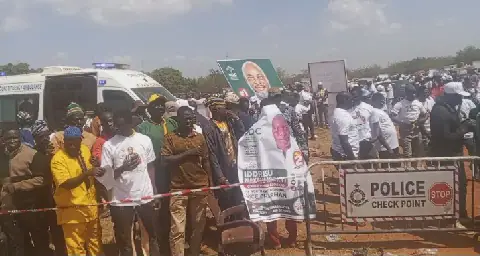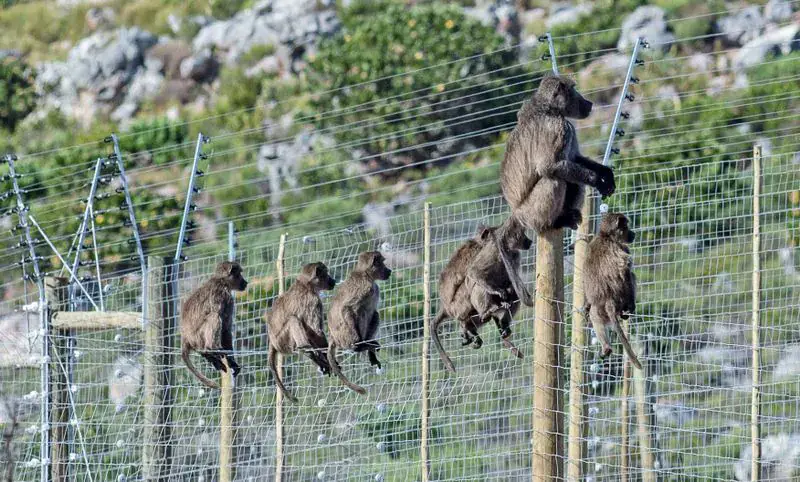
A protest was held outside the Cape Town Urban Wildlife Centre in Kogelfontein, South Africa, on Sunday, where over 100 people gathered to mourn the capture of 44 baboons from the Waterfall troop in Simon's Town. The baboons were lured into baited cages by monitors and are now being held behind an electric fence at the wildlife centre. Protesters, including Penelope Georgia from Noordhoek, came to grieve for the animals and the ecosystem they inhabited.
The capture operation, which was carried out by a team of monitors and naval personnel, was met with resistance from some protesters who had been trying to prevent the capture for months. On Saturday, a protester attempted to pull a tarpaulin off a cage on the back of a bakkie transporting a caged baboon, while another group barred the bakkie from driving into the centre's premises. The City of Cape Town issued a statement saying the relocation was done as a last resort and that all baboons arrived safely and unharmed at the wildlife centre.
The captured baboons are being held in a 2.3-hectare enclosure at the wildlife centre, where healthy males will be vasectomised and mature females will be given contraceptive implants. A young baboon taken on Friday could spend the next 30 years in the enclosure. The City said one old female baboon was euthanised after a health screening revealed a growth on her chest, fluid in her bowels, and no teeth. The capture operation has sparked controversy, with some protesters arguing that it was not necessary and that the baboons could have been managed in the wild.
Researcher Dr Dave Gaynor expressed concerns about the capture operation, saying that it was unclear what would happen to any baboons left behind. Activist Gerry Higgs said she was traumatised by the experience and that the effort to keep the troops in the wild had been lost. The Cape Baboon Partnership said a veterinary examination had confirmed that an alpha male baboon from the Groot Olifantsbos troop was found dead with a projectile wound to the chest.
The protest on Sunday was peaceful, with protesters sitting on the grass and gazing at the enclosure where the captured baboons were being held. Bunches of flowers were tied to the fence, and posters condemned the capture. Megan Carr of the EMS Foundation said that people had been given no warning or opportunity to provide input on the capture operation, leading to frustration and anger.
Local nutritional therapist Amy Morris has written to Mayor Geordin Hill-Lewis, asking for the removal permit and supporting paperwork for the capture operation. She also requested information on the qualifications of the capture team and who was authorised to carry or use firearms. The City of Cape Town has said that the intention to relocate the baboons was clearly communicated to all affected communities over a year ago.
The capture operation has highlighted the complexities of managing baboon populations in urban areas. While some acknowledge the dangers posed by the baboons, others argue that the capture operation was not necessary and that alternative solutions could have been found. The incident has sparked a wider debate about the management of wildlife in South Africa and the need for more effective and humane solutions.
Key points
- 44 baboons were captured and relocated to the Cape Town Urban Wildlife Centre
- Protesters gathered outside the enclosure to grieve for the captured baboons
- The capture operation has sparked controversy and raised questions about the management of wildlife in urban areas