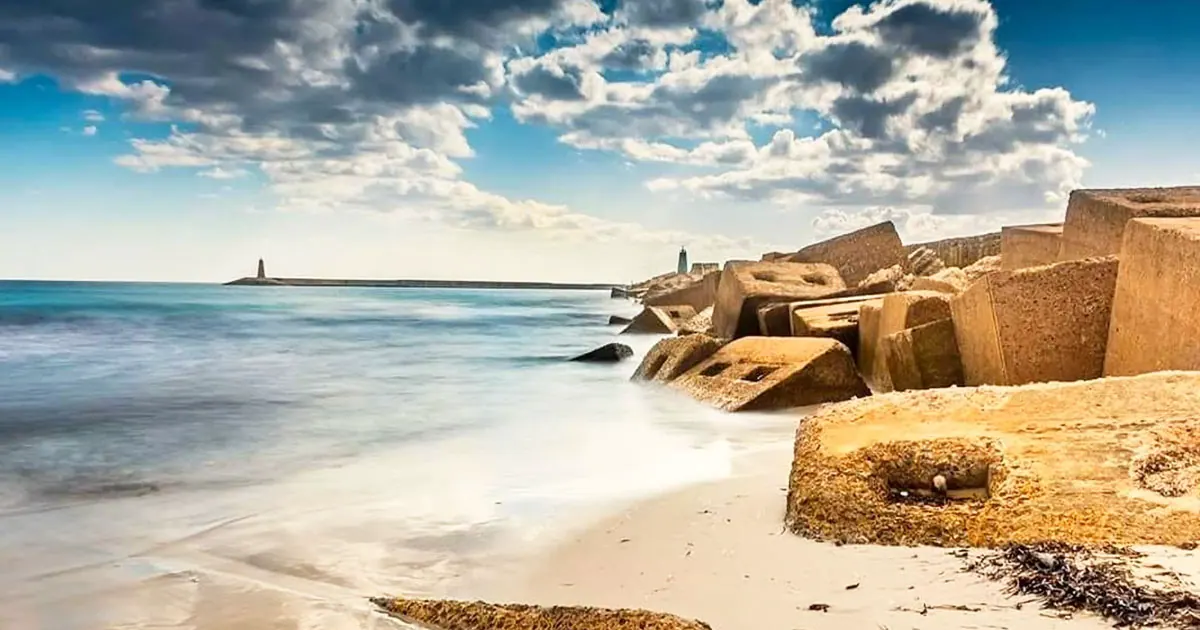
A sense of unease has settled over the residents of Bizerte, Tunisia, as a coastal protection project gets underway. The construction of a new seawall at Sidi Salem beach has sparked concerns about the impact on the local ecosystem and the future of the coastline. Despite efforts to inform the public about the project, many citizens remain worried about the effects of the construction on their environment.
The project aims to protect the coastline from erosion and involves the construction of a series of seawalls, or "épis," to trap sediment and stabilize the sand. According to Abdessalem Fezzani, an engineer with the project, the épis are designed to work in conjunction with a massive sand replenishment program to restore the beach. The project has undergone changes due to the presence of underwater communication cables in the area.
The initial plan for the project had to be revised after the discovery of the underwater cables, which were installed in 2024 and 2025. The cables required the relocation of one of the épis, and a new épi, known as épi 1 bis, was added to the project. The changes aim to minimize the impact on the cables while ensuring the stability of the coastline.
The project involves a combination of constructing targeted infrastructure and massive sand replenishment to restore the beach. The épis will act as barriers to retain sediment and slow down marine erosion. According to the project's environmental and social management plan, strict rules are in place to minimize the impact on the ecosystem. Measures are being taken to limit the disturbance of fine particles in the water and protect the local posidonia herbiers.
A local follow-up committee was established in November 2025 to ensure transparency and facilitate dialogue between citizens, associations, and project teams. The committee plays a vital role in monitoring the project's progress and ensuring that commitments are met. While it does not have decision-making authority, it provides a platform for citizens to express their concerns and participate in the project's implementation.
The project's design takes into account the dynamic nature of the coastline, with the aim of accompanying its natural movement rather than creating a fixed structure. Numerical modeling has been used to assess the impact of different scenarios on the evolution of the beach and the stability of the sand. The goal is to find an optimal profile for the beach while minimizing the impact on the environment.
The project's stakeholders are working to balance the needs of coastal protection with environmental concerns. Ongoing monitoring of the coastline will enable adjustments to be made as needed to maintain the optimal profile of the beach. The project's success will depend on the continued collaboration between citizens, associations, and project teams to ensure that the coastline is protected for future generations.
Key points
- The project aims to protect the Bizerte coastline from erosion through a combination of seawall construction and sand replenishment.
- The project has undergone changes due to the presence of underwater communication cables in the area.
- A local follow-up committee has been established to ensure transparency and facilitate dialogue between citizens, associations, and project teams.