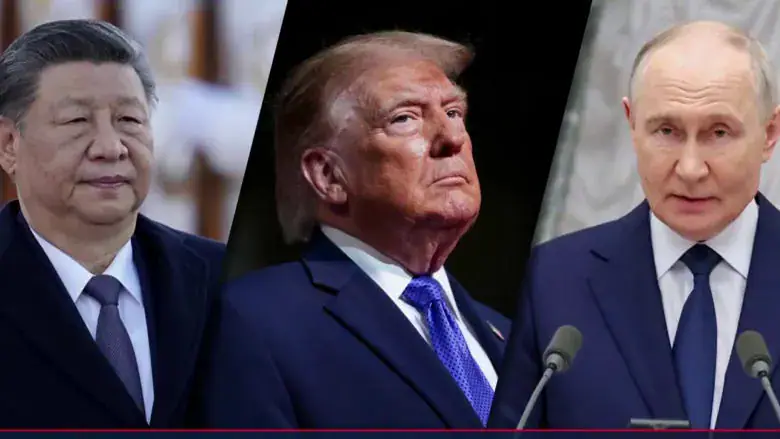
A proposed meeting between US President Donald Trump, Chinese President Xi Jinping, and Russian President Vladimir Putin in Shenzhen on the sidelines of the Asia-Pacific Economic Cooperation (APEC) summit has revived historical analogies to the 1945 Yalta Conference. The original conference addressed post-war arrangements, including Germany's occupation and reconstruction, Poland's future, and the establishment of the United Nations.
The 1945 Yalta Conference was a symbol of great-power diplomacy and unequal influence, contributing to Europe's division during the Cold War. However, the contemporary international order is shaped by various factors, including financial networks, technological standards, supply chains, energy security, digital infrastructure, and access to critical resources. Influence is exercised through multiple channels, many of which cannot be translated into clearly defined geographical spheres.
The proposed Shenzhen meeting illustrates both possibilities and limitations of great-power diplomacy. Reports indicate that the three leaders have different objectives, and prospects for a comprehensive agreement remain uncertain. Trump is interested in demonstrating diplomatic leadership, while Putin may seek to strengthen Russia's international standing and advance Moscow's interests concerning Ukraine.
The meeting may carry considerable symbolic weight without producing a substantive strategic settlement. For Trump, the encounter offers an opportunity to project an image of personal diplomatic influence. For Xi, it presents both an opportunity to demonstrate China's convening power and a risk of appearing to endorse a model of international relations in which the largest states determine global politics boundaries.
A more important issue lies beyond the intentions of the three leaders, concerning the position of countries not represented at the table but whose security, territorial integrity, and economic interests may be affected by decisions taken there. Ukraine is the most immediate example, and any discussion of the war that excludes Kyiv would raise fundamental questions about sovereignty and international agreements legitimacy.
The same concern extends to other regions where major-power competition intersects with unresolved territorial disputes, security commitments, and fragile political arrangements. Taiwan represents another dimension of this problem, and any potential understanding between the US and China would be a matter of profound regional and international consequence.
The Middle East presents a complex picture, with regional conflicts, energy routes, military deployments, and competing security partnerships creating a dense network of interests involving the US, Russia, China, and regional actors. Local governments, political movements, and non-state actors possess their own agendas, sources of leverage, and capacity to disrupt external calculations.
Key points
- The proposed meeting between Trump, Xi, and Putin has sparked comparisons to the 1945 Yalta Conference.
- The contemporary international order is shaped by various factors beyond military strength and territorial control.
- The meeting's outcome may have significant implications for countries not represented at the table, including Ukraine and Taiwan.