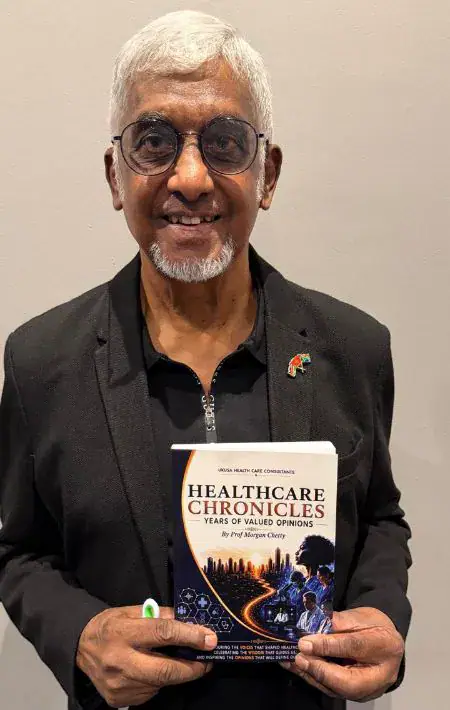
Professor Morgan Chetty has published a book titled 'Healthcare Chronicles', a collection of over 80 articles written over 14 years for local and international healthcare publications. The book argues that sustainable healthcare systems require evidence, collaboration, and stronger primary care. As a registered specialist family physician and visiting professor at the Durban University of Technology, Chetty brings a wealth of experience to the discussion. His work has been influenced by his Master's degree in Public Health, earned on a Fulbright-Humphrey scholarship in the United States.
The book covers a wide range of subjects, including managed care, medical ethics, artificial intelligence, and universal health coverage. A central theme of the book is that healthcare policy and reform must be informed by evidence, professional knowledge, and constructive engagement rather than ideology or vested interests. Chetty's work is particularly relevant in South Africa, where the healthcare sector is facing numerous challenges, including limited access to quality healthcare and escalating costs. The book provides valuable insights into the challenges facing the industry and the thinking needed to build more accessible, affordable, and sustainable healthcare systems.
One of the key messages in 'Healthcare Chronicles' is that technology should not be viewed merely as an administrative convenience but as an instrument to improve patient access, engagement, and the delivery of services. Chetty explores how artificial intelligence and digital platforms could transform healthcare in his article "Technology and AI to Improve Patient Experience and Patient Engagement". This discussion is particularly pertinent at a time when healthcare systems face mounting pressure to become more efficient and responsive. The book also examines the growing influence of artificial intelligence and digital technology in healthcare delivery.
The collection of articles also highlights the importance of primary healthcare in strengthening health systems. Chetty draws attention to the need to strengthen the position of primary healthcare doctors, who frequently find themselves undervalued and under-resourced. In his article "If Primary Care is the Cornerstone of a Strong Healthcare System, Why Do Primary Care Doctors Feel So Neglected and Cast Aside?", Chetty raises an important contradiction. Primary healthcare is widely recognised as the foundation of an effective and sustainable health system, yet general practitioners often face significant challenges.
Chetty also addresses the dilemma of balancing affordability with quality and patient outcomes in his article "Is it Possible to Deliver Better Care at Lower Costs?". He argues that containing expenditure cannot simply mean restricting access or cutting services. Instead, it requires identifying waste, reducing unnecessary interventions, and directing resources towards treatments and services that genuinely benefit patients. This debate is relevant to medical schemes, healthcare providers, policymakers, and patients. The article "Challenges Facing Health Systems in Africa" broadens the discussion to the continental level, highlighting inadequate infrastructure, shortages of healthcare professionals, and limited access to medicines as significant obstacles.
The book is an important resource for everyone involved in healthcare, from practitioners and administrators to policymakers, academics, and students. Its wide-ranging discussions offer valuable insights into the challenges facing the industry and the thinking needed to build more accessible, affordable, and sustainable healthcare systems. As a collection of articles written over 14 years, 'Healthcare Chronicles' provides a record of changing healthcare priorities, persistent systemic weaknesses, and emerging thinking that could influence the future of the industry.
The launch of 'Healthcare Chronicles' in Durban this week marks a significant contribution to the discussion on healthcare reform in South Africa. As the country grapples with the implementation of universal health coverage, Chetty's work provides a timely and important resource for stakeholders. The book's emphasis on evidence-led reform and constructive engagement is likely to resonate with healthcare professionals, policymakers, and patients alike.
Key points
- The book argues that sustainable healthcare systems require evidence, collaboration, and stronger primary care.
- Chetty's work highlights the importance of technology in improving patient access, engagement, and the delivery of services.
- The book provides valuable insights into the challenges facing the healthcare industry and the thinking needed to build more accessible, affordable, and sustainable healthcare systems.
Reporting sources
- Morgan Chetty's 'Healthcare Chronicles' makes the case for evidence-led reform · The Independent on Saturday