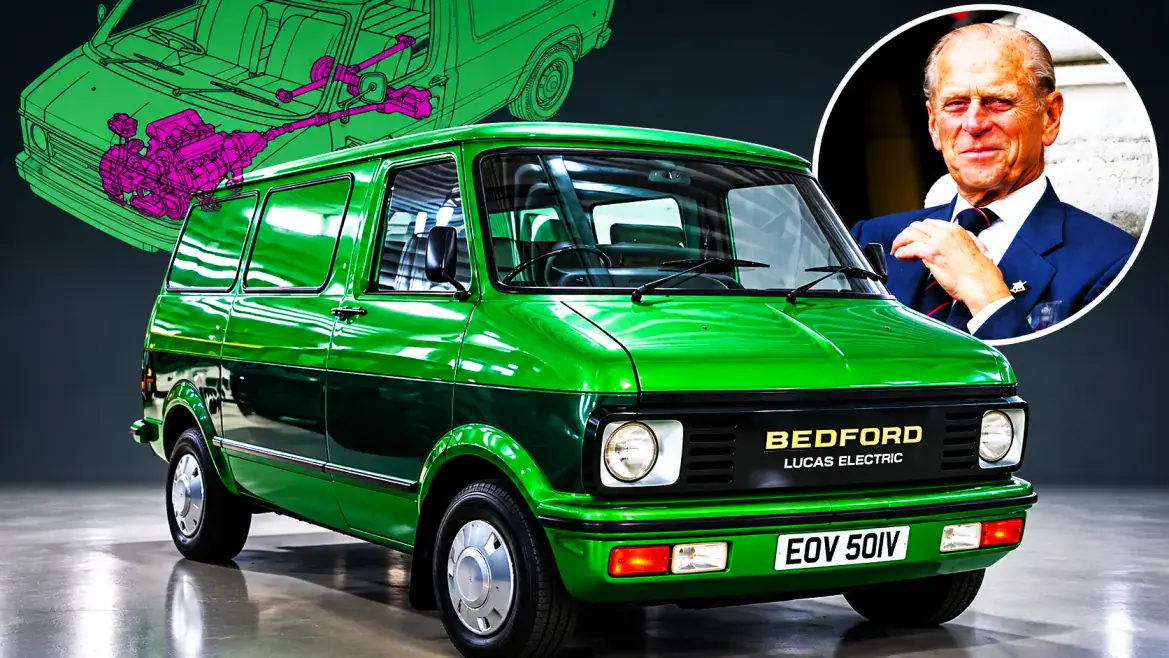
In the 1980s, Prince Philip, the Duke of Edinburgh, was already exploring zero-emission transportation, driving a heavily modified 1980 Bedford CF panel van. This electric vehicle was a result of an £8 million joint venture between Bedford and Lucas-Chloride EV Systems. The goal was to clean up urban delivery fleets, and over 400 production vans were reportedly built at Dunstable.
The electric CF van attracted international attention, with the Royal Mail running trials across London and Sheffield. The National Aeronautics and Space Administration (NASA) in the United States evaluated prototype units at testing grounds in Michigan, while General Motors imported dozens to America under the “GM Griffon” badge. Prince Philip commissioned a bespoke six-seater passenger version, finished in metallic paint with a plush leather interior.
The van was equipped with a 40-kilowatt Lucas electric motor powered by a 216-volt lead-acid battery pack mounted beneath the floor. The setup featured regenerative braking to recapture energy during deceleration. To address heating issues, engineers installed a tiny diesel-powered unit beneath the floor to keep the royal cabin warm through winter. Prince Philip regularly drove the battery-electric Bedford through central London, enjoying its silent operation.
Prince Philip's connection to Tanzania dates back to 1961 when he visited the country, then known as Tanganyika, to represent Queen Elizabeth II during the country's independence celebrations on December 9th. He piloted himself in a hired plane to Tanzania, with stops in Zanzibar and the northern regions of Arusha. Eighteen years later, Prince Philip accompanied Queen Elizabeth II on an official state visit to Tanzania in July 1979.
The Bedford CF was a classic full-size panel van produced from 1969 to 1987, built by Bedford, the commercial vehicle division of Vauxhall, a subsidiary of General Motors. The Ford Transit, which the Bedford CF aped in design, was introduced earlier in 1965 and is still in production today under various configurations.
Prince Philip's one-off electric royal shuttle is preserved at the British Motor Museum at Gaydon, standing as an eccentric monument to Britain's early and ambitious electric vehicle experiments. However, when government development grants expired, the commercial numbers no longer added up, and the Bedford CFE van eventually disappeared from production.
Today, Prince Philip's legacy in Tanzania and the UK is remembered, with his eldest son, Prince Charles, undertaking a famous afternoon walking safari through the Arusha National Park in 2011. Prince Philip passed away in 2021, leaving behind a history as the longest-serving royal consort in British history, having served as consort of the British monarch from Queen Elizabeth II's accession on February 6, 1952, until his death.
Key points
- Prince Philip drove a modified 1980 Bedford CF panel van, pioneering electric mobility in the UK.
- The electric CF van was a result of an £8 million joint venture between Bedford and Lucas-Chloride EV Systems.
- Prince Philip visited Tanzania in 1961 and 1979, leaving a legacy in the country.
Reporting sources
- How Prince Philip pioneered electric mobility in the 80s, driving a modified Bedford panel van · The Tanzania Times – News from Tanzania, Africa, World, Breaking News, Weather, Environment and Climate Change