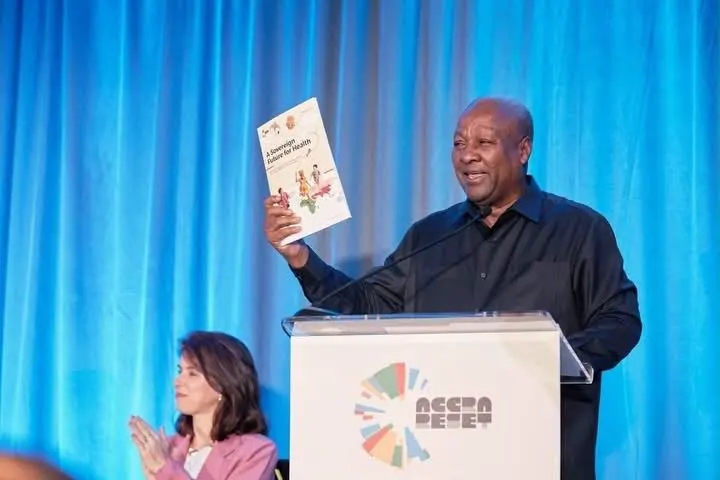
President John Dramani Mahama of Ghana has officially launched the final report of the High-Level Panel on the Accra Reset, titled A Sovereign Future for Health, at the 81st United Nations General Assembly in New York. The report calls for a new global approach to health governance, giving Global South countries greater control over their health systems and resources. This launch took place during a high-level side event on the Accra Reset: Global Reset Dialogue on September 21, 2026.
The High-Level Panel on the Accra Reset was established to translate the Accra Reset agenda into practical policy proposals. President Mahama emphasized that the recommendations should now move from design to implementation. He stated that the initiative emerged from concerns over the growing vulnerability of countries in the Global South to external decisions on trade, finance, and development assistance. The President identified three major challenges facing the Global South as geostrategic marginalization, geopolitical vulnerability, and donor dependence.
According to President Mahama, Ghana's domestic development agenda aligns closely with the objectives of the Accra Reset, particularly in areas such as economic self-reliance, local value addition, public health infrastructure, and transparent governance. He cited efforts to strengthen Ghana's pharmaceutical manufacturing capacity as an example, arguing that health security should not depend entirely on foreign suppliers for essential medicines. President Mahama stressed that a national reset without a global reset would be unfeasible.
A key message of the report is the principle that countries cannot claim ownership of development programs without having meaningful control over the decisions and resources that shape them. President Mahama highlighted that the Global South had achieved political independence but continued to have limited influence over major global trade, financial, and health governance structures. He stated that for decades, nations of the Global South have been asked to own the results of health and development programs, while others retain control.
President Mahama cautioned that greater control must be accompanied by accountability at the national level. He emphasized that moving power from distant boardrooms into an unaccountable ministry would not magically manifest sovereignty. If they demand control, they must earn it through uncompromising domestic accountability. In Ghana's Resetting Ghana Agenda, they are tightening fiscal controls, fighting corruption, and ensuring that every public cedi is accounted for.
The A Sovereign Future for Health report contains 10 practical recommendations that will guide the next phase of the Accra Reset. President Mahama said Ghana and the Presidential Council would engage governments, global health institutions, development finance organizations, philanthropies, and the private sector to translate the recommendations into country-level agreements. The initiative will also seek partnerships with institutions in Africa, India, Indonesia, the Gulf, and elsewhere to build networks connecting research, regulation, local manufacturing, and distribution.
President Mahama stressed that the initiative was not intended to promote isolationism but rather pragmatic interdependence based on equal partnerships between countries. He noted that health was deliberately selected as the first area for the global reset because it is any human's most precious possession, with maternal and child health identified as an immediate test of the proposed policy. Nearly seven out of every 10 maternal deaths globally occur in Sub-Saharan Africa, and Ghana's maternal mortality rate remains three times above the recommended Sustainable Development Goal target.
Key points
- President Mahama launches Accra Reset report at 81st UN General Assembly
- Report calls for new global approach to health governance giving Global South countries greater control
- Initiative seeks pragmatic interdependence, not isolationism, based on equal partnerships between countries