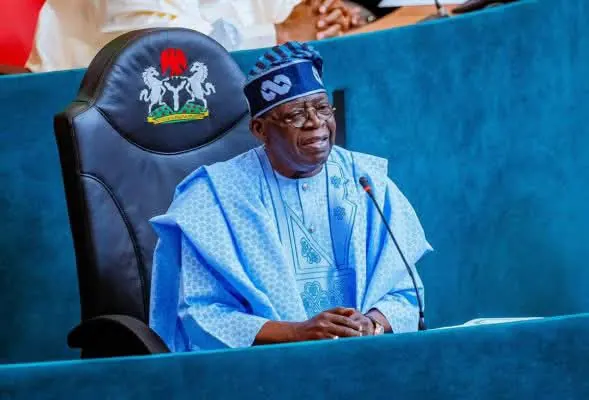
President Bola Ahmed Tinubu returned to Nigeria on Tuesday, September 30, 2026, after a working vacation in Europe. Upon his arrival at the Murtala Muhammed International Airport in Ikeja, the president addressed journalists, dismissing concerns about his health. Tinubu stated that he is "healthy, sound, and ready to go," amid rumors and concerns raised by some Nigerians and his supporters during his extended stay in France.
The president began his three-week leave on August 30, 2026, and proceeded to the United Kingdom before traveling to Paris, France. The Presidency later announced an extension of his stay, citing that Tinubu was in touch with developments back home. During his time in Paris, Tinubu had a private dinner with billionaire businessman Femi Otedola, who commended the president's economic reforms, saying they have positioned Nigeria for sustainable growth.
Femi Otedola, Chairman of First HoldCo Plc, shared his comments on Tuesday, citing developments in Nigeria's capital market, foreign exchange market, external reserves, and investment environment as signs that the reforms were producing results. He mentioned Nigeria's return to the FTSE Russell Frontier Market classification, the performance of the Nigerian Exchange, and stronger external reserves as evidence of the positive impact of Tinubu's reforms.
Six Nigerian companies, including First HoldCo, Zenith Bank, Guaranty Trust Holding Company, Dangote Cement, Aradel Holdings, and MTN Nigeria, were included in the FTSE Frontier 50 Index, which took effect on September 21, 2026. Market analysts view this development as potentially significant for the visibility of Nigerian equities among international investors.
The International Monetary Fund (IMF) supports Otedola's assessment of improved macroeconomic conditions, while also highlighting significant challenges. In its June 2026 Article IV assessment, the IMF noted that reforms implemented over the preceding three years had strengthened macroeconomic stability, rebuilt external buffers, and improved the functioning of the forex market.
The IMF estimated Nigeria's real GDP growth at 4 percent in 2025 and projected 4.1 percent growth for 2026. However, the Fund cautioned that improved macroeconomic indicators had not eliminated pressures facing households, and higher food and fuel prices could intensify those pressures. Inflation persistence had declined following the forex reforms, but inflation remained a major concern.
President Tinubu's return to Nigeria and assurance of his good health and readiness to work come as a relief to his supporters and the general public. With the president set to resume his duties, Nigerians will be watching closely to see the implementation of his economic reforms and their impact on the country's growth and development.
Key points
- President Tinubu returns to Nigeria, assures of good health and readiness to work.
- Femi Otedola commends Tinubu's economic reforms, citing positive impact on Nigeria's economy.
- Nigeria returns to FTSE Russell's Frontier Market classification after a three-year absence.