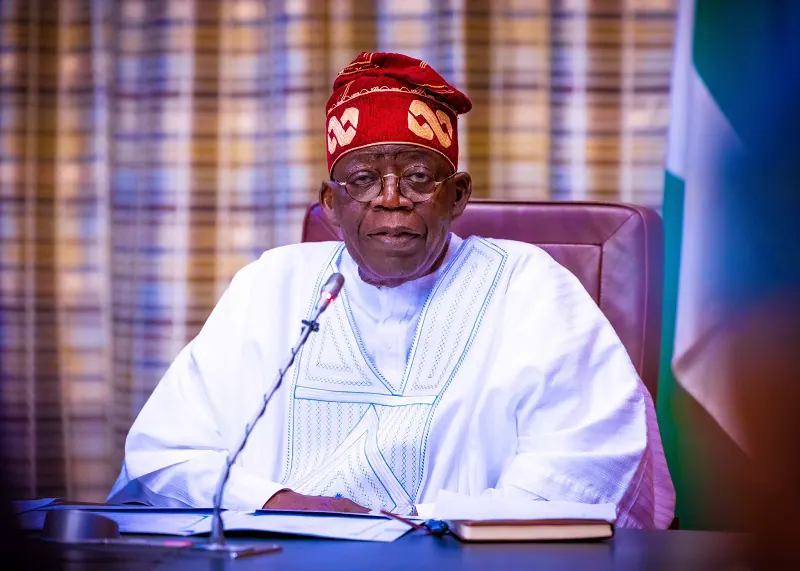
President Bola Tinubu has postponed his anticipated return to Nigeria following a sudden alteration to his travel itinerary. Initially scheduled to arrive this weekend, his return has been tentatively shifted to Tuesday. The President will land in Lagos and spend up to a week there before proceeding to Abuja. Tinubu originally departed Nigeria for London on August 30 for a scheduled three-week working vacation.
During his time in Europe, Tinubu engaged in strategic meetings with French President Emmanuel Macron and prominent businessman Vincent Bolloré in Paris. The presidency formally announced on September 21 that Tinubu had extended his stay abroad by a few days, assuring the public that he would return by the weekend. Presidential aides maintained that he remained in constant contact with officials at home, continuing to direct government affairs from abroad.
The prolonged absence and latest delay have fueled a growing constitutional debate regarding the transfer of executive powers. Opposition figures and civil society groups have raised questions about Tinubu's compliance with the 1999 Constitution. Section 145 of the Constitution mandates that the President must transmit a written declaration to the Senate President and the Speaker of the House of Representatives when proceeding on vacation.
This declaration officially empowers the Vice-President to perform executive functions in an acting capacity. The debate was complicated when Vice-President Kashim Shettima departed for New York on September 20 to lead Nigeria's delegation at the 81st United Nations General Assembly. Shettima had been representing Tinubu at various official domestic functions.
In an effort to quell the mounting political tension, Senate President Godswill Akpabio addressed the issue earlier in the week. He firmly declared that there is no power vacuum in the country, assuring the nation that despite his physical absence, President Tinubu remains fully in charge of the country's affairs.
The President's absence has also sparked concerns over the country's governance. With Tinubu away for nearly a month, questions have been raised about the impact on the country's affairs. The presidency has maintained that the President remains in control, but the delay has raised concerns about the need for clarity on the transfer of executive powers.
The delay in Tinubu's return has sparked a mix of reactions from different quarters. While some have expressed concern over the constitutional implications, others have called for calm, citing the President's continued engagement with officials at home. The situation remains a subject of interest, with many awaiting the President's return and the potential implications for the country's governance.
Key points
- President Tinubu delays return to Nigeria due to last-minute change in plans.
- The delay sparks constitutional debate over transfer of executive powers.
- Senate President assures no power vacuum in the country.