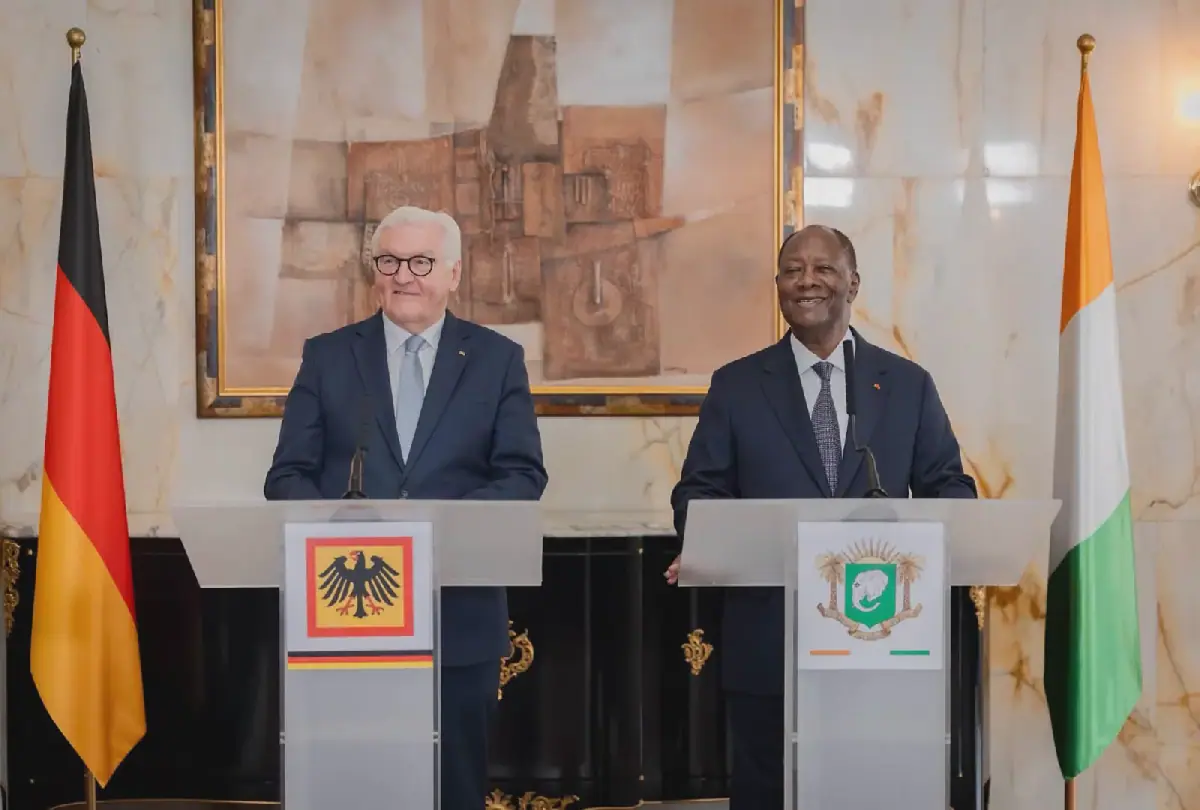
Côte d'Ivoire and Germany are seeking to strengthen their economic ties, with President Frank-Walter Steinmeier's official visit to Abidjan marking a significant milestone in their bilateral relations. The visit, which took place on November 23, 2026, is the first by a German head of state in 43 years. During the visit, President Steinmeier met with his Ivorian counterpart, Alassane Ouattara, to discuss ways to enhance their economic cooperation.
The current economic partnership between Côte d'Ivoire and Germany is substantial, with bilateral trade valued at over 918 billion FCFA per year. The two countries also have a significant portfolio of projects financed through the German Development Bank (KfW) and the German International Cooperation Agency (GIZ), worth around 635 billion FCFA. However, President Ouattara expressed his ambition to take their economic partnership to the next level, citing the need for more concrete investments and commercial opportunities.
President Ouattara emphasized the importance of transforming their partnership into tangible economic benefits, highlighting the potential for growth in various sectors, including infrastructure, agro-industry, mining, energy, healthcare, and education. He invited German investors to participate in the financing of Côte d'Ivoire's National Development Plan (PND) 2026-2030, which outlines the country's economic priorities. The plan offers opportunities for German companies to invest in key sectors.
The two leaders also discussed other areas of cooperation, including energy, biodiversity, forest restoration, vocational training, and private sector promotion. They agreed to strengthen their collaboration in these areas, with the next round of intergovernmental negotiations scheduled for November 26-27, 2026. Climate change and renewable energy development were also on the agenda, with both countries recognizing the need for sustainable solutions.
President Steinmeier reaffirmed Germany's commitment to supporting Côte d'Ivoire, particularly in the current international context where financial resources are scarce. He emphasized the importance of building dynamic and mutually beneficial economic relations, highlighting Côte d'Ivoire's essential role as a partner in West Africa. He also praised Côte d'Ivoire's economic weight in the Francophone sub-Saharan region and its role in regional dynamics.
The visit also touched on diplomatic and security issues, with the two leaders discussing global concerns, including tensions in the Sahel and Horn of Africa, the situation in Ukraine, and crises in the Gulf. They acknowledged the impact of these conflicts on global economic balances, particularly on oil and cereal prices. President Ouattara and President Steinmeier expressed their convergence on peace, security, and international law.
The visit concluded with President Steinmeier being elevated to the dignity of Grand Cross of the National Order of the Republic of Côte d'Ivoire. The German president also visited the Yopougon vocational school and the International Academy for Counter-Terrorism in Jacqueville. The strengthened economic partnership between Côte d'Ivoire and Germany aims to go beyond development aid, with a focus on concrete investments and increased trade.
Key points
- Strengthening economic ties between Côte d'Ivoire and Germany.