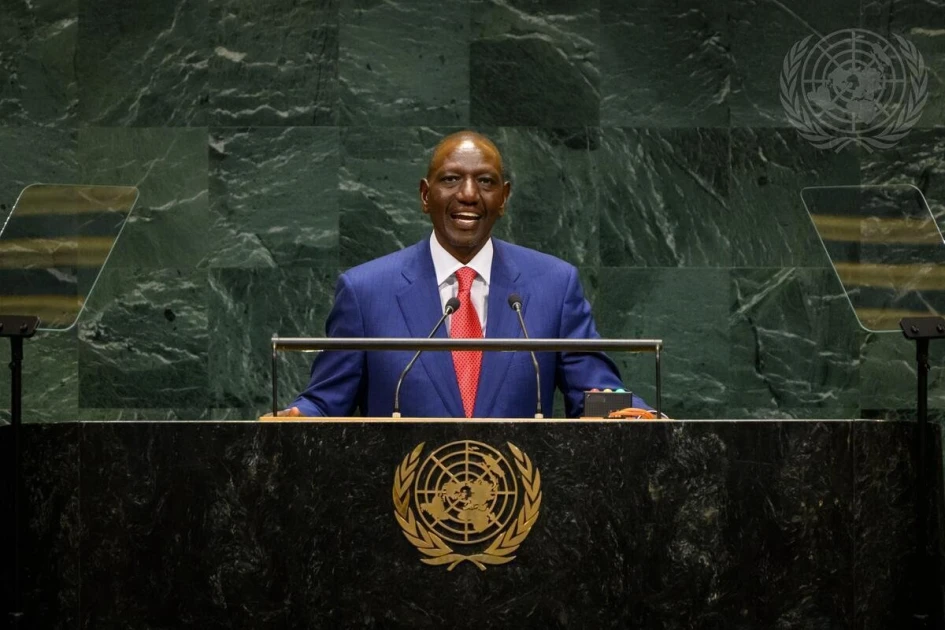
Kenyan President William Ruto addressed the 81st United Nations General Assembly in New York, emphasizing the need for reform in the global institution. He called for an end to the current Security Council structure, which reserves permanent power and veto authority for five countries, while excluding the other 188 Member States. This structure, he argued, is unfair and must be corrected to give Africa a voice in global decisions. Africa's 54 nations are currently excluded from permanent membership, despite being frequently affected by the Council's decisions.
President Ruto stressed that every nation has one vote and is sovereign and equal under the UN Charter. However, the current system allows five nations to possess permanent power and veto authority, while the other 188 do not. He emphasized that reform must give Africa equitable and permanent representation, with all the prerogatives and privileges of permanent membership. This would enable Africa to have a meaningful voice in decisions that shape global peace and security.
The President pointed out that the current international security architecture was designed when most of Africa was under colonial rule and had no voice in shaping global institutions. He noted that only four African countries were represented at the 1945 San Francisco conference that established the UN. President Ruto called for urgent reform to restore trust in the UN and ensure that every nation has a stake and every child has a future.
President Ruto also called for reform of the international financial architecture to give every nation a fair opportunity to secure the wellbeing of its people. He noted that global public debt reached a record $102 trillion in 2024, with developing countries accounting for less than a third of that debt. However, they paid about $1 trillion in interest that year alone. This has led to a situation where 46 developing countries now spend more on interest than on health or education.
The President emphasized that nations must manage debt prudently, strengthen institutions, deepen domestic capital markets, honor contracts, and confront corruption without equivocation. He added that a fairer international system requires responsibility on both sides and that reform abroad cannot substitute for accountability at home. President Ruto also called for multilateral development banks to lend more and for greater use of guarantees, risk-sharing instruments, long-term finance, and local currency financing.
President Ruto warned that failure to build an effective UN, capable of preventing conflict, defending peace, and advancing development, would come at a heavy cost to civilians. He noted that children would be driven from classrooms, families displaced, hospitals would collapse, and economies would be consumed by war. The President emphasized that peace is not separate from development and that it is the first condition for development.
On the domestic front, President Ruto announced that Kenya expects to break ground on the East Africa Refinery in Lamu, a facility capable of processing 700,000 barrels of oil a day with an investment of $16 billion. He noted that this project represents the Africa that Kenya seeks to build, adding value at home, creating jobs, and building industries capable of serving continental and global markets.
Key points
- President Ruto calls for UN Security Council reform to give Africa equitable and permanent representation.
- The President also urges reform of the international financial architecture to give developing countries a fair opportunity to secure the wellbeing of their people.
- Kenya is set to break ground on the East Africa Refinery in Lamu with an investment of $16 billion.