President William Ruto officially unveiled the newly completed mausoleum of former Prime Minister Raila Odinga on Wednesday, October 7, at Kang’o ka Jaramogi in Bondo, Siaya County. The mausoleum, constructed under the supervision of the Ministry of Defence and technical teams from the National Museums of Kenya, stands adjacent to the shrine of Raila’s late father, Kenya’s first Vice President Jaramogi Oginga Odinga. The structure is a memorial rich in architectural geometry, political symbolism, and historic memory.
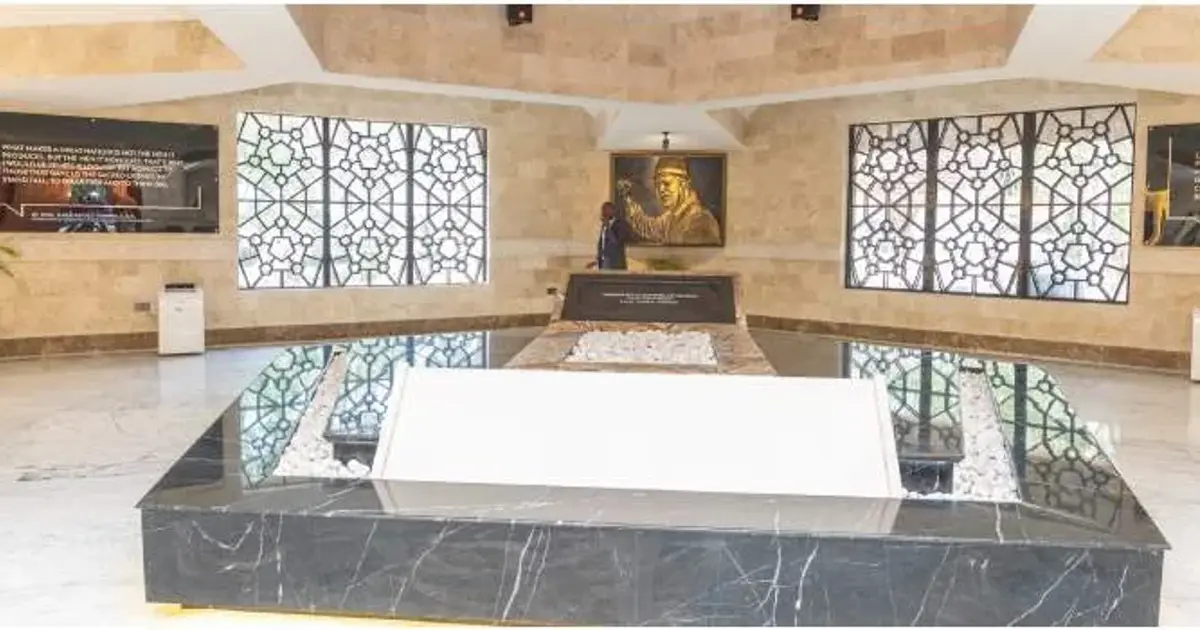
The defining feature of the memorial is its pentagonal structure, designed to create visual and symbolic harmony with Jaramogi Oginga Odinga’s nearby hexagonal mausoleum. The pentagon carries deep political significance, mirroring "The Pentagon," the iconic political coalition formed under the Orange Democratic Movement (ODM) ahead of the 2007 general elections. This coalition was assembled by Raila and brought together prominent national leaders, including Musalia Mudavadi, William Ruto, Joe Nyaga, Najib Balala, and Charity Ngilu.
Inside the mausoleum, walls feature curated historical photographs documenting pivotal eras of Raila’s life, alongside his famous public statements. An excerpt from his 2020 Madaraka Day address is prominently displayed: “Let us reflect on patriotism, sacrifice, personal responsibility, dignity of our people, and respect for our nation.” The visual journey traces his trajectory from his early academic days to his return home and subsequent detention without trial during the one-party era.
The memorial integrates symbols long associated with Raila's public persona, including The Raised Fist, a hallmark of his political rallies, and The Buffalo (Jowi), a traditional chant and cultural symbol used during his political career. These symbols represent authority, popular mobilization, unity, strength, and a collective call to action. The mausoleum is listed for protection by the National Museums of Kenya as a protected national heritage site.
The mausoleum is intended to serve as a heritage center and "living classroom," exhibiting Afrocentric historic materials and political archives. The facility aims to host visitors, students, and researchers from across the globe interested in learning about African history and democratic struggles. This initiative ensures that future generations can learn from Raila Odinga's legacy and contributions to Kenyan politics.
Raila Odinga died on October 15, 2025, at the age of 80, while receiving treatment in India, and was buried at the family home four days later on October 19. The dedication of his mausoleum marks a permanent tribute to his national legacy at the historic Oginga family homestead. The ceremony was attended by President William Ruto, who recognized Raila Odinga's significant impact on Kenya's democratic journey.
The unveiling of Raila Odinga's mausoleum is a significant milestone in honoring his decades-long political journey and enduring legacy. The mausoleum serves as a testament to his contributions to Kenya's democratic struggles and his role in shaping modern Kenyan governance. Key aspects of the mausoleum's design and significance have been highlighted, including its architectural harmony and symbolic features.
Key points
- President William Ruto unveiled Raila Odinga's mausoleum in Bondo, Siaya County, on October 7.
- The mausoleum's pentagonal structure symbolizes the Orange Democratic Movement's "The Pentagon" coalition.
- The facility is intended to serve as a heritage center and "living classroom" for future generations.