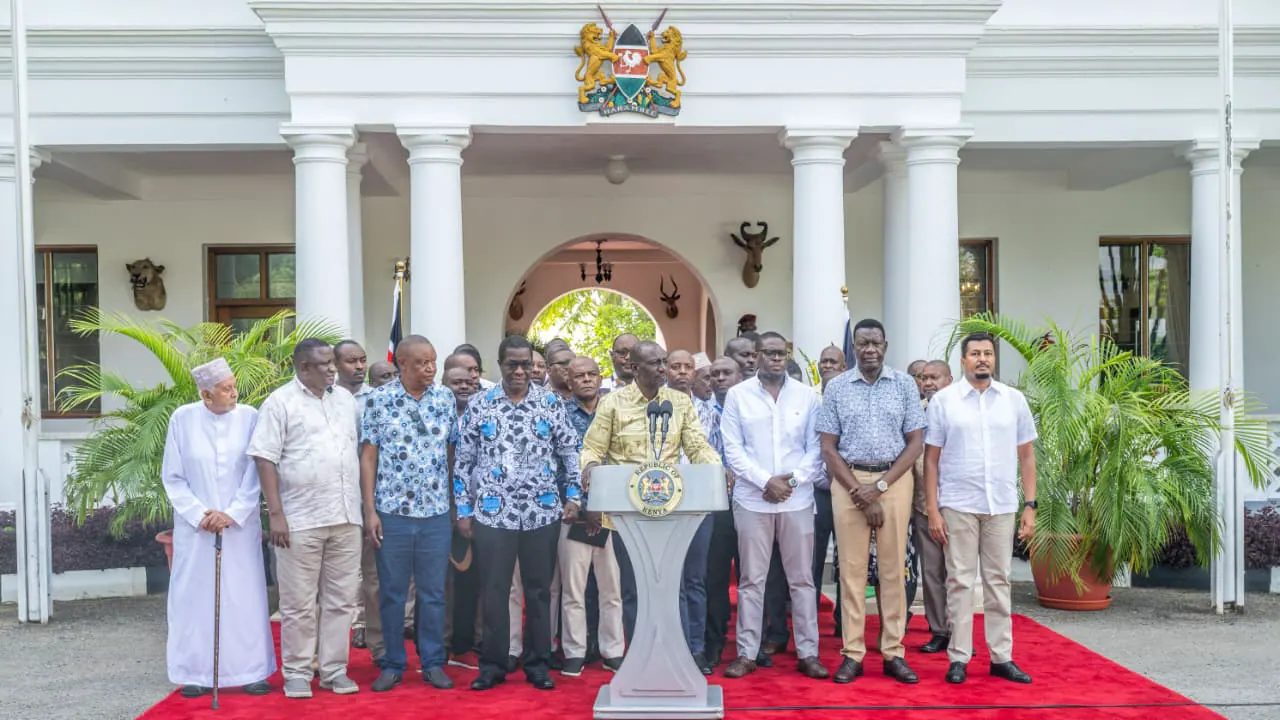
On May 22, 2026, President William Ruto addressed the nation, outlining the government's plan to mitigate the effects of the global fuel crisis on Kenyan citizens. He revealed that the government has been using the Petroleum Development Fund and reducing Value Added Tax (VAT) from 16 to 8 per cent to stabilise fuel prices. The President's address followed a consultative meeting with transport stakeholders at State House Mombasa.
President Ruto directed that diesel prices be reduced by KSh10 in the June-July pricing cycle. He also highlighted the government's commitment to supporting Kenyans through fuel price stabilisation measures and tax relief interventions. In the April-May and May-June 2026 pricing cycles, the government committed KSh28.19 billion to cushion Kenyans from high fuel prices. Specifically, during the May-June 2026 pricing cycle, the government utilised KSh7.7 billion to stabilise prices and foregone KSh8 billion in VAT revenue.
The President noted that without government intervention, fuel prices would be significantly higher. Super Petrol would be retailing at KSh230.12 a litre instead of the current KSh214.25, diesel at KSh277.75 instead of KSh232.86, and kerosene at KSh270 instead of KSh191.38. He stated that government interventions have protected millions of Kenyans from severe economic hardship. The President acknowledged the burden rising fuel prices have placed on families, businesses, farmers, and transport operators.
Global fuel prices have risen sharply, with Super Petrol increasing by 54.4 per cent, diesel by 118.5 per cent, and kerosene by 126.4 per cent. President Ruto emphasised that no country can completely escape a global oil shock of this magnitude. Even advanced economies are facing similar challenges. He noted that the government's intervention has ensured a stable and uninterrupted fuel supply under the Government-to-Government fuel framework.
The President warned against scrapping all taxes and levies on fuel, citing the potential impact on public services. He asked if the country should revert to stalled road projects. President Ruto emphasised that leadership requires responsible decisions that balance current needs and long-term economic stability. The government is engaging stakeholders to develop practical interventions aimed at reducing pressure on livelihoods and economic activity.
To address the crisis, the government is accelerating investments in renewable energy, electric mobility, and modern public transport. President Ruto announced plans to buy 3,000 electric vehicles for use by security and administration officers. He also declared that the first 100,000 electric vehicles imported to Kenya will be duty-free. The government is working towards establishing a regional refinery to strengthen energy security.
President Ruto called on Kenyans to remain calm and patient as the country navigates the global fuel crisis. He urged citizens to reject hooliganism and violence that could undermine the economy. The President committed the government to continuing engagement with stakeholders across the transport sector to develop practical and sustainable solutions that protect livelihoods and support economic activity.
Key points
- The Kenyan government has committed KSh28.19 billion to cushion citizens from high fuel prices.
- President Ruto has announced measures to support the transport sector, including temporary relief measures for transport operators facing financial challenges.
- The government is accelerating investments in renewable energy, electric mobility, and modern public transport to reduce dependence on fossil fuels.