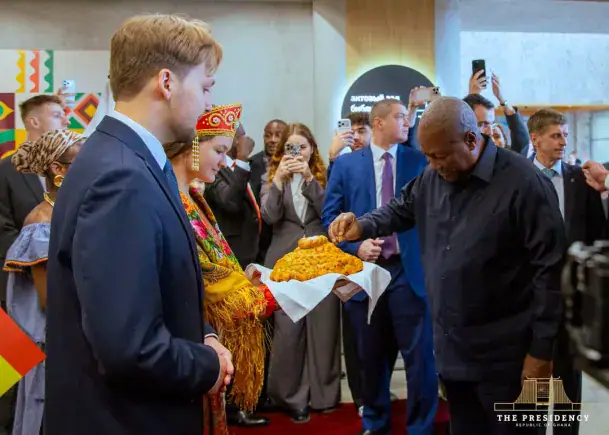
Ghanaian President John Dramani Mahama is in Moscow, exploring alternative energy sources, including nuclear power, to drive the country's industrialisation agenda. During an open dialogue session with students of the Russian University of Transport, President Mahama disclosed that Ghana's current electricity generation mix is insufficient to support the processing of the country's minerals. He emphasized the need for a dependable and affordable power supply to facilitate the refining and value addition of Ghana's natural resources, including gold, bauxite, and manganese.
President Mahama's visit to Moscow includes a bilateral meeting with Russian President Vladimir Putin, which he expects to open new areas of cooperation. The President expressed optimism that the meeting will lead to increased investments in Ghana, particularly in the energy sector. He also used the visit to press for a ceasefire in the Russia–Ukraine war and stronger cooperation in education, transport, and energy. The President's discussions with Russian officials may pave the way for Ghana to look to Russia for nuclear technology and financing.
The President's vision for Ghana is centered on converting the country's improving macroeconomic indicators into tangible opportunities for young people. He emphasized that his administration's focus is on creating jobs and setting the stage for the country to industrialise. President Mahama has repeatedly pointed to falling inflation and a recovering currency as evidence of stabilisation, but has insisted that the gains must be felt in households through employment.
Ghana has long debated nuclear power, with successive governments commissioning feasibility studies and site assessments, but no plant has been built. The country's generation mix remains dominated by hydro and thermal sources, with solar contributing a small share. President Mahama's remarks in Moscow suggest that Accra may be prepared to look to Russia for the technology and financing, a move that would carry both energy security and geopolitical implications.
The President's comments on nuclear energy signal a possible new frontier in Ghana–Russia cooperation, with Moscow's state nuclear corporation among the world's leading builders of nuclear power plants. Russia has advanced technology in nuclear energy, and Ghana is looking to work with Russia to add nuclear energy to its mix. This potential partnership could have significant implications for Ghana's energy security and economic development.
President Mahama was conferred with an honorary doctorate by the Russian University of Transport, and he used the visit to engage with students and faculty. The session provided an opportunity for the President to share his vision for Ghana's development and to learn from Russian experts in various fields. The visit also underscores the importance of education and knowledge sharing in strengthening Ghana–Russia relations.
The third Russia–Africa Summit, which opens on October 28, provides a platform for President Mahama to engage with other African leaders and Russian officials on issues of mutual interest. The summit is expected to focus on strengthening cooperation between Russia and Africa in various fields, including energy, education, and trade. President Mahama's participation in the summit reflects Ghana's commitment to deepening its relations with Russia and other African countries.
Key points
- Ghana is exploring nuclear energy as a potential source of electricity to support its industrialisation agenda.
- President Mahama's visit to Moscow aims to strengthen Ghana–Russia cooperation in energy, education, and trade.
- The President's discussions with Russian officials may lead to increased investments in Ghana's energy sector.