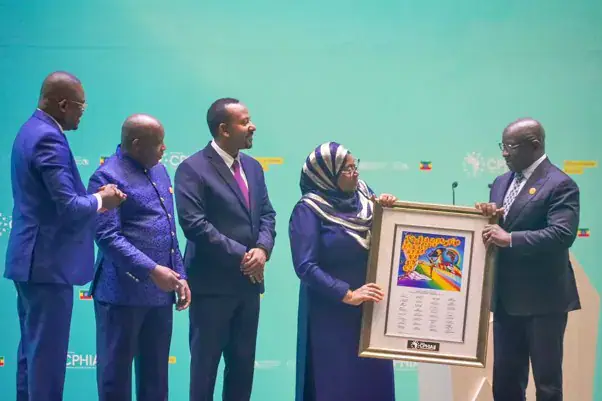
President Julius Maada Bio of Sierra Leone has received the Grand Award for Continental Health Solidarity and Political Mobilisation at the 5th International Conference on Public Health in Africa (CPHIA 2026) in Addis Ababa. The award recognises his leadership of the 300 Days of Activism for Triple Zero campaign, launched in March 2026 to eliminate preventable maternal and child deaths and reach unvaccinated children. Bio's efforts have led to a 33.8% reduction in maternal deaths and a 12.1% decline in child deaths since the campaign began.
The 300 Days of Activism for Triple Zero campaign, implemented by Health Minister Dr Austin Demby, has achieved significant milestones. The initiative has reached 10,764 zero-dose children with life-saving vaccines, surpassing its national target of 9,006. The campaign relied on weekly accountability reviews involving the Ministry of Health, hospitals, and district teams to identify gaps and assign corrective actions. This collaborative approach has contributed to the decline in maternal and child deaths in 15 of Sierra Leone's 16 districts.
However, President Bio acknowledged that maternal deaths have increased in Freetown, the capital city. He attributed this to delays in referral and emergency care, highlighting the need to strengthen emergency obstetric care, improve ambulance referrals, and ensure facilities have trained personnel, blood supplies, and essential medicines. Bio stressed that sustained monitoring and public accountability remained essential to achieving further progress.
Bio also used the platform to call for greater African health sovereignty, citing Sierra Leone's National Health Compact signed in December 2025. The compact requires an estimated US$1.27 billion over five years, with the government intending to finance 30 percent domestically. He renewed Sierra Leone's offer to share its emergency response expertise with countries facing outbreaks, referencing the 2014 Ebola experience and the current outbreak in the Democratic Republic of Congo.
The President invited African leaders and Africa CDC Director-General Dr Jean Kaseya to Freetown on December 12, 2026, for the launch of the National Health Compact. The event will showcase the campaign's accountability model, and the capital's maternal health crisis will be a key focus. Bio's acknowledgement of Freetown's reversal suggests the government is aware that aggregate national statistics can mask localised crises.
The published announcement did not provide detailed baseline figures or methodology used to calculate the reported reductions, a gap that independent observers may scrutinise as the campaign moves into its next phase. Despite this, the award and recognition of Sierra Leone's progress in reducing maternal and child deaths demonstrate the country's commitment to improving its healthcare system.
President Bio's speech emphasised that behind every statistic was a woman, a family, and a life that mattered. He cautioned that the country was "not declaring victory," stressing the need for continued efforts to address the remaining challenges. The continental health award serves as a testament to Sierra Leone's progress, but also highlights the work that remains to be done to achieve sustainable improvements in maternal and child health.
Key points
- President Maada Bio receives continental health award for reducing maternal and child deaths in Sierra Leone.
- Freetown experiences a spike in maternal deaths, attributed to delays in referral and emergency care.
- Bio calls for greater African health sovereignty and offers to share Sierra Leone's emergency response expertise with other countries.