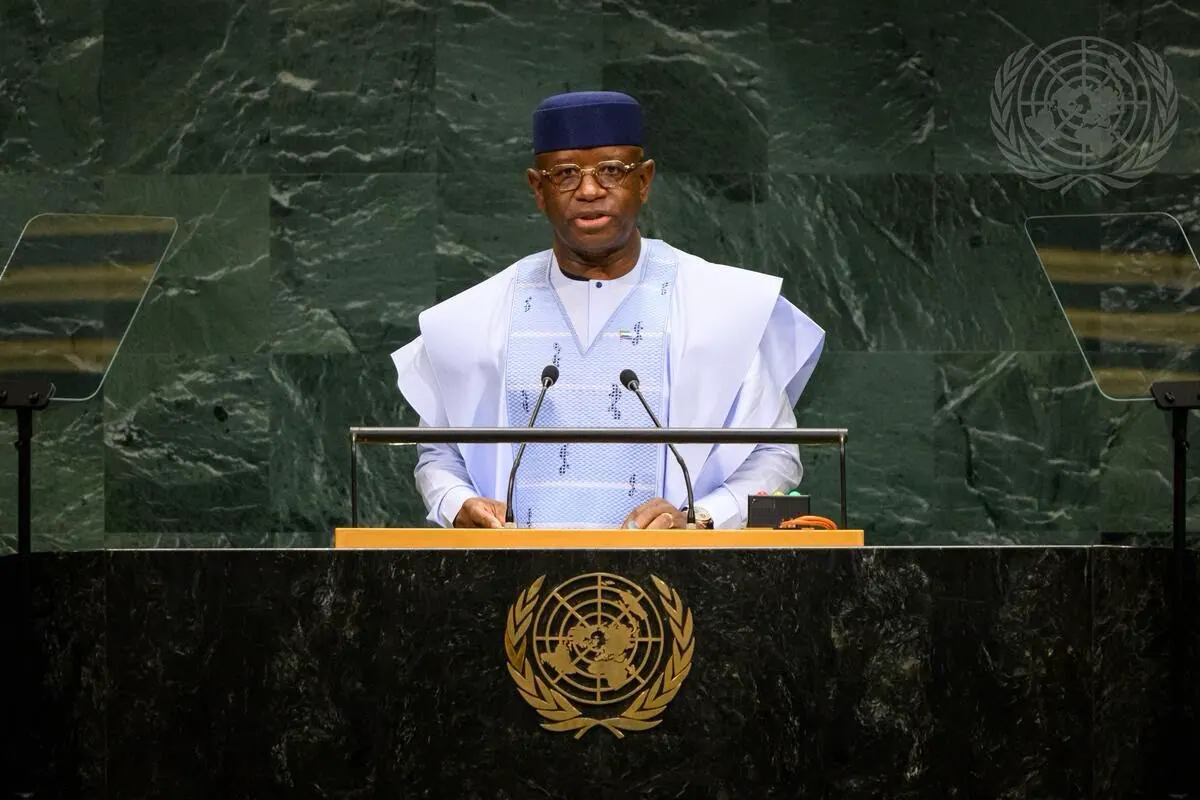
On 22 September 2026, President Julius Maada Bio of Sierra Leone addressed the United Nations General Assembly in New York, emphasizing the need for urgent global reforms. He drew from his country's experience with civil war and recovery to tackle pressing issues such as war, inequality, and climate change. The theme of the assembly, “Restoring Trust, Managing Transformation: A United Nations That Delivers for All,” guided Bio’s address. His speech was part of Sierra Leone’s broader agenda at the assembly, which included discussions on Africa’s representation on the Security Council and investment.
Bio reflected on Sierra Leone’s transition from war to peace nearly 25 years ago, underscoring that real peace comes from community reconciliation and institutional rebuilding. He noted the United Nations played a key role in this process. The President stressed that military action alone cannot ensure lasting peace in the face of poverty and unemployment. Citing conflicts in Sudan and the Democratic Republic of Congo, he remarked that military action may contain a threat but cannot build lasting peace on its own.
Bio connected development directly to security, calling for more investment in jobs and opportunities, particularly for the youth. He pointed out that global military spending reached approximately $2.9 trillion in 2025 and questioned whether enough resources were allocated to mitigate conflict drivers. This, he argued, is crucial for achieving lasting peace and security. The President’s emphasis on development and security underscored the interconnected nature of these issues.
Addressing Africa’s representation in decision-making, Bio argued that the current Security Council framework is outdated. He advocated for at least two permanent and five non-permanent seats for Africa, ensuring the continent has a stronger voice in international institutions. During his meeting with UN Secretary-General António Guterres, Bio received support for enhanced African representation. This move is seen as a step towards more equitable global governance.
Bio also discussed how Africa can better utilise its mineral resources for economic growth. He called for local processing of critical minerals vital for the green energy transition, asserting that Africa should not repeat the exploitative practices of the past. This approach aims to ensure that Africa’s natural resources contribute to its economic development rather than being exploited by external actors.
On the sidelines of the assembly, Bio highlighted Sierra Leone’s commitment to ending child marriage at a high-profile event. He announced plans for a national action plan to eliminate child marriage and align these efforts with broader goals in education and healthcare. This initiative reflects Sierra Leone’s dedication to addressing critical social issues that affect its development.
Sierra Leone’s participation at UNGA81 underscored a cohesive message: that peace, development, and equitable representation are interconnected. Bio concluded by stressing that the ideals of “For All” should not just be rhetoric but should lead to tangible progress in global policy decisions affecting peace and development. The President’s speech and engagements at the assembly highlighted Sierra Leone’s active role in global affairs and its commitment to contributing to solutions for pressing international challenges.
Key points
- President Bio advocates for urgent global reforms at the UNGA81.
- Bio calls for enhanced African representation in international institutions.
- Sierra Leone commits to ending child marriage with a national action plan.