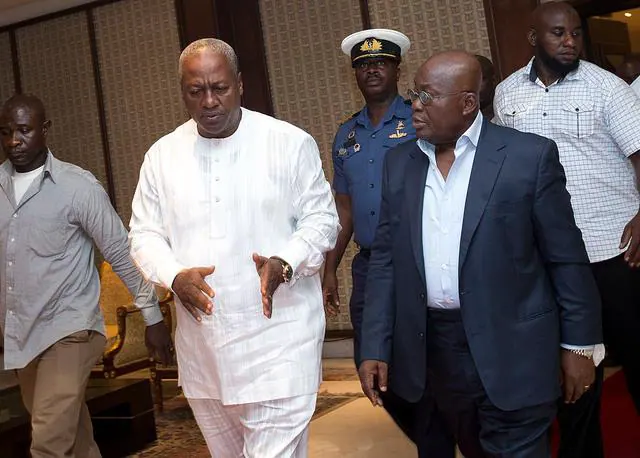
The discourse surrounding teacher welfare in Ghana's pre-tertiary sector highlights a sharp divide between past administrative policies and present challenges. The stability of the educational sector depends on fair remuneration, functional allowances, and career progression. A comparative evaluation of John Dramani Mahama's tenure alongside Nana Addo Dankwa Akufo-Addo's administration reveals distinct approaches to addressing these systemic demands.
During Nana Akufo-Addo's tenure, several structural benefits and administrative mechanisms were implemented or maintained to support educators. These included the Professional Development Allowance (PDA), Digital Allowance, Professional Licensing and Renewal, as well as Accelerated Promotional Timelines. The PDA provided financial support to cover higher education tuition or specialized short courses for career advancement, with GH₵2,400 paid to professional teachers annually.
The Digital Allowance, an annual GH₵800 allowance, was provided to assist teachers in securing data for research and integrating digital tools into teaching. A professional licensing system was also introduced to elevate teaching into a recognized professional niche similar to law or accountancy. Licenses were automatically renewed and financed through designated allowances, relieving teachers of associated financial burdens.
The current administration, led by John Mahama, has faced friction with pre-tertiary teacher unions over ongoing welfare gaps and unfulfilled commitments. These include housing promises versus salary disparities, salary arrears, allowance delays or abolitions, and communication gaps. Senior pre-tertiary administrators earn around GH₵6,000, a figure far below equivalent ranks in audit, security, and statutory services.
Persistent delays in clearing promotional back-pay and initial salary arrears for newly recruited teachers remain a major concern. Some arrears are over 12 months old, leaving teachers financially helpless. Historical policy shifts, such as the initial cancellation of teacher trainee allowances, and friction surrounding the implementation of the Single Spine Salary Structure (SSSS), continue to shape perceptions.
Misalignments between sector stakeholders, government ministries, and teacher unions have complicated negotiations. Messages from the sector minister, Haruna Iddrisu, and the Fair Wages and Salaries Commission often conflict. Although not a primary cause of the strike, issues such as the introduction of Chinese and Arabic in basic schools exemplify policy inconsistencies.
Some records indicate that in terms of teacher welfare, employment, promotion, and education in general, the former president, Nana Akufo-Addo, has historically been more favourable toward teachers. Despite stark comparisons, attention must also be given to the broader plans President Mahama claims to have for teachers—such as housing schemes and fixing salary disparities within the public sector.
Key points
- The Professional Development Allowance (PDA) provided GH₵2,400 to professional teachers annually to cover higher education tuition or specialized short courses for career advancement.
- Senior pre-tertiary administrators in Ghana earn around GH₵6,000, a figure far below equivalent ranks in audit, security, and statutory services.
- Persistent delays in clearing promotional back-pay and initial salary arrears for newly recruited teachers remain a major concern, with some arrears over 12 months old.