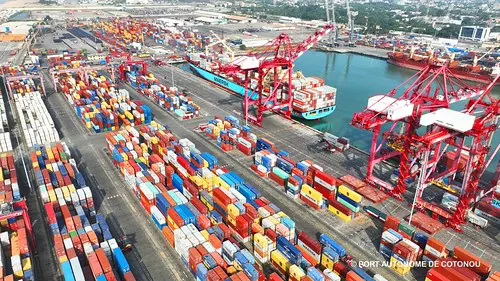
The Port autonome de Cotonou (Pac) in Benin has reported significant growth in trade with neighboring countries. In 2025, the port's traffic increased to 14.7 million tons, up from 9.6 million tons in 2024. This growth is attributed to the port's efforts to diversify its trade corridors, particularly with Burkina Faso, Nigeria, and Chad. Kevin Potier, Director of Commercial and Marketing at Pac, presented the port's performance at the "Pac Media Connect" event in Cotonou.
The port's trade with Burkina Faso has seen a notable increase, with nearly 1 million tons of goods, mostly hydrocarbons, transiting through the port to the landlocked country. In 2025, 39.2% of the port's traffic was in transit, with 16% destined for Burkina Faso. This growth is a result of the port's strategic location and its efforts to strengthen its position as a regional trade hub. The port's proximity to Burkina Faso and its ability to handle large volumes of cargo have made it an attractive option for traders.
Nigeria has also become a significant market for the Port of Cotonou, with the port serving as a gateway for goods destined for the country. The congestion of several Nigerian ports, combined with Benin's proximity, has favored the passage of goods through the Port of Cotonou. According to Kevin Potier, the port is working to further increase its trade with Nigeria and has seen significant growth in traffic with the country.
The Port of Cotonou is also exploring opportunities to increase trade with Chad. Although the volumes are currently low, the port is working to position itself as a primary entry point for goods destined for Chad. N'Djamena has been actively seeking to diversify its supply routes, and the Port of Cotonou is well-positioned to benefit from this trend. In July 2025, a delegation from the Chadian Council of Shippers visited the Port of Cotonou to explore opportunities for cooperation.
Despite the diplomatic tensions between Benin and Niger, the Port of Cotonou continues to play an important role in Niger's trade. However, the nature of the trade has shifted, with Niger now using the Sèmè-Podji platform, located near Cotonou, to export its hydrocarbons. In 2025, the platform handled approximately 4.3 million tons of cargo, primarily from Niger.
The Port of Cotonou's activities have seen significant growth in recent years. In 2025, the port handled 14.7 million tons of cargo, including 9 million tons of imports and 5.7 million tons of exports. The port's containerized traffic also exceeded 500,000 EVP. In the first half of 2026, the port handled 7.7 million tons of cargo, with export volumes reaching 2.87 million tons, up from 2.16 million tons in the same period last year.
The Port of Cotonou's growth is expected to continue, driven by its strategic location and efforts to diversify its trade corridors. The port's ability to handle large volumes of cargo and its proximity to several landlocked countries make it an attractive option for traders. As the port continues to strengthen its position as a regional trade hub, it is likely to play an increasingly important role in the region's economic development.
Key points
- The Port of Cotonou has seen significant growth in trade with Burkina Faso, Nigeria, and Chad.
- The port's traffic increased to 14.7 million tons in 2025, up from 9.6 million tons in 2024.
- The port is working to further increase its trade with Nigeria and has seen significant growth in traffic with the country.