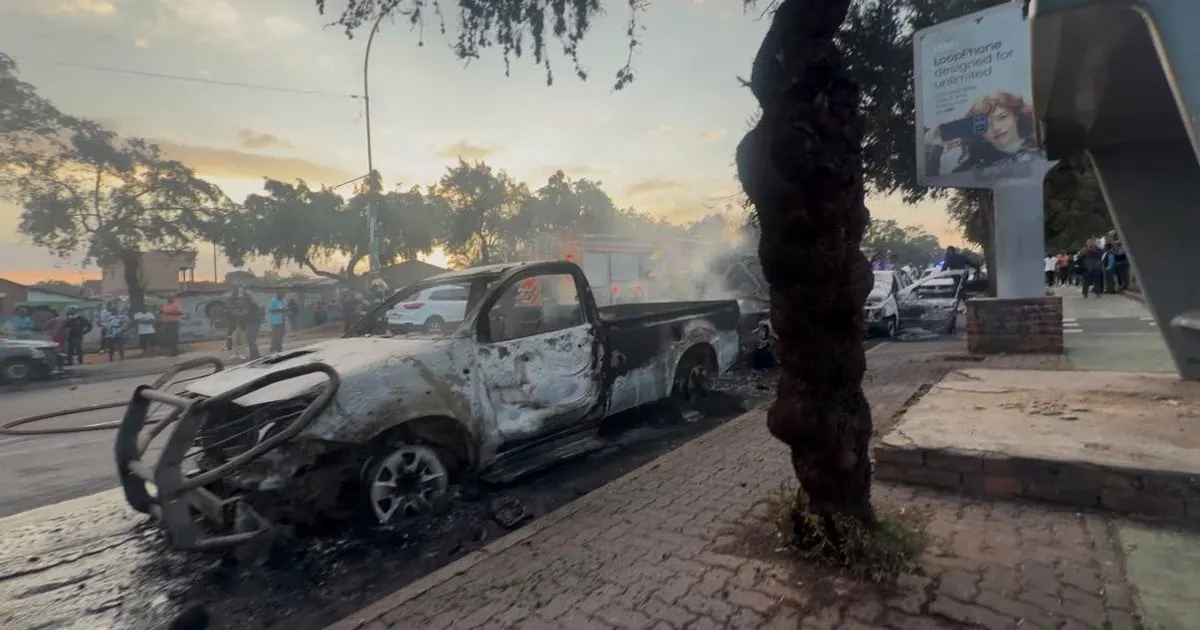
A wave of violent anti-immigration protests swept through Durban and Soweto on October 8, 2026, leaving a trail of destruction in its wake. Twenty-four vehicles were torched, shops were vandalized and looted, and several individuals were left injured. Protesters blocked roads, pelted shops with stones, and forced the closure of foreign-owned businesses, prompting police to deploy stun grenades and cordon off volatile areas. The protests were sparked by a directive from the Department of Home Affairs, issued on September 28, 2026, following a Constitutional Court ruling in July 2026.
The Constitutional Court ruling struck down provisions of the Refugees Act that barred people from applying for asylum if they entered the country irregularly or failed to report to a Refugee Reception Office within five days. The ruling requires the Department of Home Affairs to give asylum seekers an opportunity to submit an application so that their individual claims can be evaluated on merit. However, organizations like March and March have spread false claims that the ruling amounts to an "invasion" or an automatic mass-granting of rights. According to Malaika Mahlatsi, this misinformation has contributed to the current wave of violence.
The Refugee Convention, which South Africa is a signatory to, defines who a refugee is and sets out their fundamental rights. The Convention has three core principles, including non-discrimination of refugees, not penalizing asylum seekers who enter or are present in a country without authorization, and not expelling or returning an asylum seeker to a territory where their life or freedom would be threatened. The Constitutional Court ruling is in alignment with these principles, but the government has been criticized for not doing enough to address misinformation and prevent the violence.
The distinction between an asylum seeker and a refugee is crucial in understanding the current situation. An asylum seeker is a person who has fled their home country and asked for protection in another country but has not yet received a legal decision on their application. A refugee is an asylum seeker whose claim has been officially processed and recognized under international or domestic law as having a well-founded fear of persecution, war, or violence. The persecution must be founded on race, religion, nationality, political opinion, or an alliance with a particular social group.
The current situation in South Africa is not unique, with many countries around the world enforcing stricter immigration laws. In the European Union, updated laws have introduced safe third country rules, allowing member states to reject asylum applications as inadmissible and transfer applicants to a third country. However, some countries have implemented much stricter rules, which have been widely condemned by European courts, rights groups, and other European governments.
The government has been forced into a reactive posture, compelled to correct misunderstandings and misinterpretations in an environment that has already been contaminated by misinformation and disinformation. The government should have known that the Constitutional Court ruling would be sensitive in a country that, just four months ago, was confronted with a terrifying possibility of the repeat of the 2008 violence that claimed tens of lives and led to the displacement of thousands of foreign nationals.
The violence has resulted in a significant disruption to the lives of foreign nationals and South Africans alike. Hundreds of foreign nationals queued outside offices like the Umbilo/Durban Refugee Reception Centre following the Department of Home Affairs directive. The government and other stakeholders must work together to address the root causes of the violence and find a solution to the current crisis.
Key points
- The Constitutional Court ruling is grounded in international legal principle and practice.
- Misinformation and poor leadership have contributed to the current wave of violence.
- The government has been criticized for not doing enough to address misinformation and prevent the violence.